The Illusion of Sovereignty: Lebanon’s Struggle in theShadow of Hezbollah
November 2025, written by Yara Chaptini
Introduction
On the night of September 25, 2025, the limestone cliffs of Beirut’s “Raouché” were illuminated by the faces of Hezbollah’s late leader Hassan Nasrallah and his successor Hashem Safieddine. The projection, organized by Hezbollah supporters to commemorate their assassination during the war against Israel roughly one year earlier, was meant to be a symbolic tribute. Instead, the rally of remembrance sparked public outrage. Despite a government ban on public illuminations at the national landmark and explicit instructions from the Mohafez (governor) of Beirut prohibiting any projection onto the cliffs, the event went ahead.
In the days that followed, Prime Minister Nawaf Salam and other officials condemned the act as a challenge to the authority of the state and its institutions. Yet, no concrete measures were taken. The discrepancy between words and action revealed something greater than a singular act of civil disobedience. It exposed, once again, Lebanon’s struggle to assert genuine state sovereignty in the presence of a powerful non-state actor capable of defying its authority with impunity. Hezbollah, both a political party and an armed militia, has long challenged Lebanon’s fragile monopoly of force. Since its emergence during the 1980s, the movement has evolved from a resistance group against Israeli occupation into a dominant political player. Despite formally asserting its de jure sovereignty, defined as “the power of a country to control its own government”, the Lebanese government still struggles to translate this authority into practical control or effective governance (Cambridge Dictionary). This article examines the Lebanese state’s perennial failure to assert state sovereignty, analyzing how its response to Hezbollah’s continued armament exposes the inherent limitations of state authority in a political landscape where the movement often operates as a ‘state within a state’. It first outlines the historical background of Hezbollah’s rise and Lebanon’s legal commitment to disarmament, then turns to more recent developments, including the post-2024 war landscape, the government’s disarmament plan, and the Raouché incident, to eventually evaluate the state’s capacity to enforce its authority. The discussion then assesses whether Lebanon’s actions constitute genuine sovereignty or an externally driven compliance measure, concluding with two possible futures for the Lebanese state.
Background and Context
1. The Historical Role of Hezbollah in Lebanon
a. Hezbollah
Hezbollah (حزب الله), whose name translates to “Party of God”, emerged in the early 1980s as a product of regional turmoil. Founded amid the 1982 Israeli invasion and inspired by Iran’s Islamic Revolution of 1970, the movement was guided, backed, and trained by Tehran’s Islamic Revolutionary Guard Corps (IRGC). Its political theology was grounded in the doctrine of wilāyat al-faqīh, which places ultimate authority in the hands of the supreme Islamic scholar, defined by Iran’s clerical leadership. As such, since its founding, Hezbollah has affirmed a transnational dimension to its mission, adhering to the political and religious direction of Ayatollah Khomeini and his successors – thereby maintaining loyalty to an external religious authority over the Lebanese state from which it originates (Council on Foreign Relations). The movement’s identity underwent a rapid transformation: from a focused militant network dedicated to “resistance” against foreign occupation (specifically Israel), it expanded into a robust political and religious organization. This new trajectory committed the movement both to protecting Lebanon’s Shi’a community and to challenging and rebalancing its role within the confessional system historically dominated by Maronite and Sunni elites (Robinson).
b. The Taif Agreement
Marked by the profound fragmentation of state authority and institutional collapse, the Lebanese Civil War (1975-1990) concluded with the emergence of Hezbollah as a uniquely disciplined and ideologically cohesive force. The movement differentiated itself from other militias through its dual mission: executing jihad against Israel, and cultivating an “Islamic resistance society”, known popularly as moukawama islamiya. The 1989 Taif Agreement, brokered in Saudi Arabia to end the conflict and inaugurate the Second Republic, explicitly aimed to restore Lebanese sovereignty through the reassertion of state authority over all armed groups. Taif mandated the dissolution of all Lebanese and non-Lebanese militias and the transfer of their weapons to the state within six months of ratification. The objective was for the state to reclaim its monopoly of legitimate force (Jalkh).
However, the Taif Agreement was undercut by a second, more ambiguous clause. A separate chapter, titled “Liberating Lebanon from the Israeli occupation”, mandated that the government take “all the steps necessary” to liberate all Lebanese territories, restore sovereignty, and deploy the national army to the south (United Nations). Hezbollah’s leadership leveraged this ambiguity, interpreting it as the legal and moral basis for its sustained armed resistance, arguing that disarming the movement would actively contradict Taif’s own stated objective of liberation. As senior Hezbollah official Mohammad Raad, asserted: “Those who reject the resistance reject Taif” (Jalkh). This stance is strongly contested by opposition figures, largely from Christian political parties, who deem Hezbollah’s “resistance” claim a distortion of the Taif Agreement and the perpetuation of militia politics under a new guise. Thus, the Taif Agreement institutionalized Lebanon’s sovereignty paradox. One on hand, it reaffirmed the state’s exclusive authority while providing Hezbollah with the political space to assert exceptional legitimacy as the nation’s “resistance”. This duality became the very foundation of Lebanon’s enduring ‘state-within-a-state’ dilemma.
International Involvement and United Nations Resolutions
When Israel withdrew from Southern Lebanon in May 2000, Hezbollah claimed the outcome as the direct result of its armed resistance – a victory the Lebanese army had proven incapable of securing. This success decisively cemented the narrative of al-muqāwama (the resistance), instating Hezbollah as the de facto national defense force rather than a mere militia subject to disarmament. This allowed the organization to reframe its arsenal as an instrument of sovereignty, fundamentally shifting the monopoly of force: it was no longer exercised by the state, but on its behalf, by a powerful entity independent of governmental control.
This tension was put to the test with the United Nations Security Council (UNSC) Resolution 1559 (2004), which reaffirmed Lebanon’s obligation to disband and disarm all militias, “Lebanese and non-Lebanese alike,” and to extend government control throughout its territory. Although the resolution didn’t explicitly name Hezbollah, it was widely understood as a direct challenge to the movement’s military autonomy. Beirut’s response was cautious, defined by political expediency, as successive governments recognized Hezbollah’s strong position within the legislature and its regional electoral base. They strategically framed the implementation of the disarmament resolution not as an immediate plan of action, but as a commitment to a long-term “national dialogue”, effectively deferring direct communication. This avoidance strategy left R. 1559 greatly symbolic, lacking any coercive effect (Abi Akl).
The July 2006 war between Israel and Hezbollah exposed the limits of this very symbolic sovereignty. In the aftermath of thirty-four days of intense bombardment, UNSC Resolution 1701 (2006) was adopted, calling for a “full cessation of hostilities,” the disarmament of Hezbollah and other armed groups, and the deployment of the Lebanese Armed Forces and UNIFIL south of the Litani River (Travers).
Together, Resolutions 1559 and 1701 encapsulate the international dimension of Lebanon’s sovereignty crisis. While both resolutions affirm the state’s theoretical monopoly of force, they simultaneously expose its absence on the ground. Through its persistent justification of arms as necessary for resistance and deterrence, Hezbollah effectively vetoes the resolutions’ implementations, symbolizing a sovereignty that remains nominal rather than operational. This stark contradiction between the international legal framework and domestic paralysis defines Lebanon’s modern political order and sets the stage for the more recent confrontations of 2024-2025.
The unresolved implementation of the two UN resolutions highlights a deeper truth about Lebanon’s political order: state sovereignty exists primarily as a legal principle rather than an empirical reality. In theory, the disarmament of militias was intended to re-establish the government’s exclusive control over coercive power. Yet, in practice, this effort revealed the structural limits of that control within a deeply sectarian system. Successive governments have consistently affirmed that weapons should remain exclusively under state control; nevertheless, Hezbollah’s arsenal continues to expose a profound deficit between de jure and de facto sovereignty.
This enduring tension is central to the question guiding this article: how has the Lebanese response to Hezbollah’s armament reflected its struggle to assert state sovereignty? The following section analyzes how this struggle has reemerged in the post-2024 landscape, specifically examining new disarmament debates and mounting external pressures that are testing the boundaries of the Lebanese state’s authority.
Current Developments (2024-2025)
Border Escalation and Costs
Two decades later, the same tension would reemerge more forcefully. The 2024 border war between Israel and Hezbollah marked Lebanon’s most destructive confrontation since 2006. Over several weeks of bombardment, Israeli airstrikes devastated infrastructure across South Lebanon, reaching the Bekaa Valley and Beirut’s southern suburb of “Dahiyeh”. Hezbollah retaliated with rocket fire towards northern Israel, compelling the Israeli military into a two-front conflict, given its concurrent operations in Gaza since October 7, 2023. This escalation triggered a severe humanitarian crisis in Lebanon, resulting in over 3,800 casualties
and displacing around 1.2 million individuals. Furthermore, Israeli bombing destroyed roughly 100,000 homes and resulted in an estimated US$8.6 billion in damage (Frankel). Beyond the physical toll, the conflict caused a strategic blow; Israeli operations targeted Hezbollah’s command structure, eliminating many of its top military field commanders, beginning with former Secretary General Hassan Nasrallah on September 27, 2024. The militia’s vast networks of tunnels and weapons depots were also destroyed. This loss of force weakened Hezbollah’s operational capabilities and removed the “invincible aura” that had underscored its legitimacy since its victory against Israel in 2006. Though the group considers itself victorious once more, the war exposed the beginning of its decline. Hezbollah, arguably, had become a movement struggling to mask its great losses behind the language of resistance and confronting, perhaps for the first time, the end of its era of unchallenged dominance (Masters).
1. State Action
In the aftermath of the war, Prime Minister Nawaf Salam, appointed in January 2025, strategically attempted to translate this moment of relative political calm into a reassertion of national sovereignty. In August 2025, his cabinet authorized the Lebanese Armed Forces to draft a comprehensive plan for the disarmament of all militias, explicitly including Hezbollah, by the end of the year. The announcement was the most direct challenge to Hezbollah’s military autonomy since the adoption of UNSC Resolution 1559 two decades earlier (Arab Center DC). The reaction was quite immediate: ministers affiliated with the “Shi’ite duo” (Hezbollah and Amal) walked out of the cabinet session before the vote, denouncing the proposal as a foreign- imposed agenda that threatened civil peace (The Meir Amit Intelligence and Terrorism Information Center). In the aftermath of the walkout, Hezbollah’s leadership reaffirmed its longstanding position. Deputy Secretary-General of Hezbollah Naim Qassem declared that the movement will remain armed and ready to face Israel, framing its weapons as a pillar of resistance and national defence, rather than a threat to state authority. His statement aimed to amplify Hezbollah’s presence, reminding supporters that Nasrallah’s death had not altered the group’s strategic position (L’Orient Today).
2. External Pressures
This initiative, despite its domestic branding as a step towards restoring national sovereignty, functioned as a direct response to U.S. policy mandates. Washington, via its special envoy Thomas Barrack, urged Beirut to present a disarmament roadmap, making the provision of future economic assistance and military aid dependent upon the government’s ability to demonstrate tangible progress in establishing state control over all weapon systems (Al Jazeera). The timing and tone of his demands unequivocally suggested that the push to disarm Hezbollah was dictated by external actors, rather than having emerged organically from internal Lebanese political consensus.
Yet, it would be inaccurate to see the initiative as purely American. Across Lebanon’s political spectrum, and increasingly within its general population, there is a growing fatigue with Hezbollah’s militarized dominance. Many Lebanese are burdened by years of recurring wars fought in the name of “resistance”. This resentment deepened after the 2020 Beirut port explosion, which many Lebanese link to Hezbollah’s storage of explosives at the site. The blast devastated entire neighborhoods of the capital, killed more than 200 people, and injured thousands (Law). As such, civilians view the group’s arms not as a shield, but as a source of instability and as a factor that makes Lebanon itself a target, placing the entire country at risk. Public sentiment reflects a desire to restore normal state authority free from the shadow of armed factions.
In his inaugural address, newly elected President Joseph Aoun appeared to align with both this public sentiment and the government’s official agenda, declaring that “weapons must lie in the hands of the state”. His statement resonated with many Lebanese who saw it as a long-overdue assertion. However, this statement was widely interpreted as an echo of Washington rather than a reflection of a unified domestic decision. Tehran, unsurprisingly, responded with defiance. During an official visit to Beirut in late August, former Iranian speaker Ali Lajarni vowed that Iran would “continue to help Hezbollah,” describing the movement as an essential regional deterrence force and a legitimate actor in Lebanon’s defence (L’Orient Le Jour). His remarks highlight how Lebanon’s internal debate over arms remains subject to the wider US-Iran confrontation.
This dynamic reveals the core paradox of Lebanon’s current juncture. While the state appears to be making demonstrable progress towards disarmament and the reclamation of its legitimate force, these efforts are accelerated by the expectations of external powers, rather than driven by genuine international consensus. As such, the country is perpetually caught between the imperative to secure its own sovereignty and the constraint that the realization of this objective is dictated by foreign agendas. This inherent tension was most vividly demonstrated in the events at the Raouché in late September 2025, a recent episode that underscores the fragility of Lebanon’s sovereignty when tested in practice.
3. The Raouché Episode
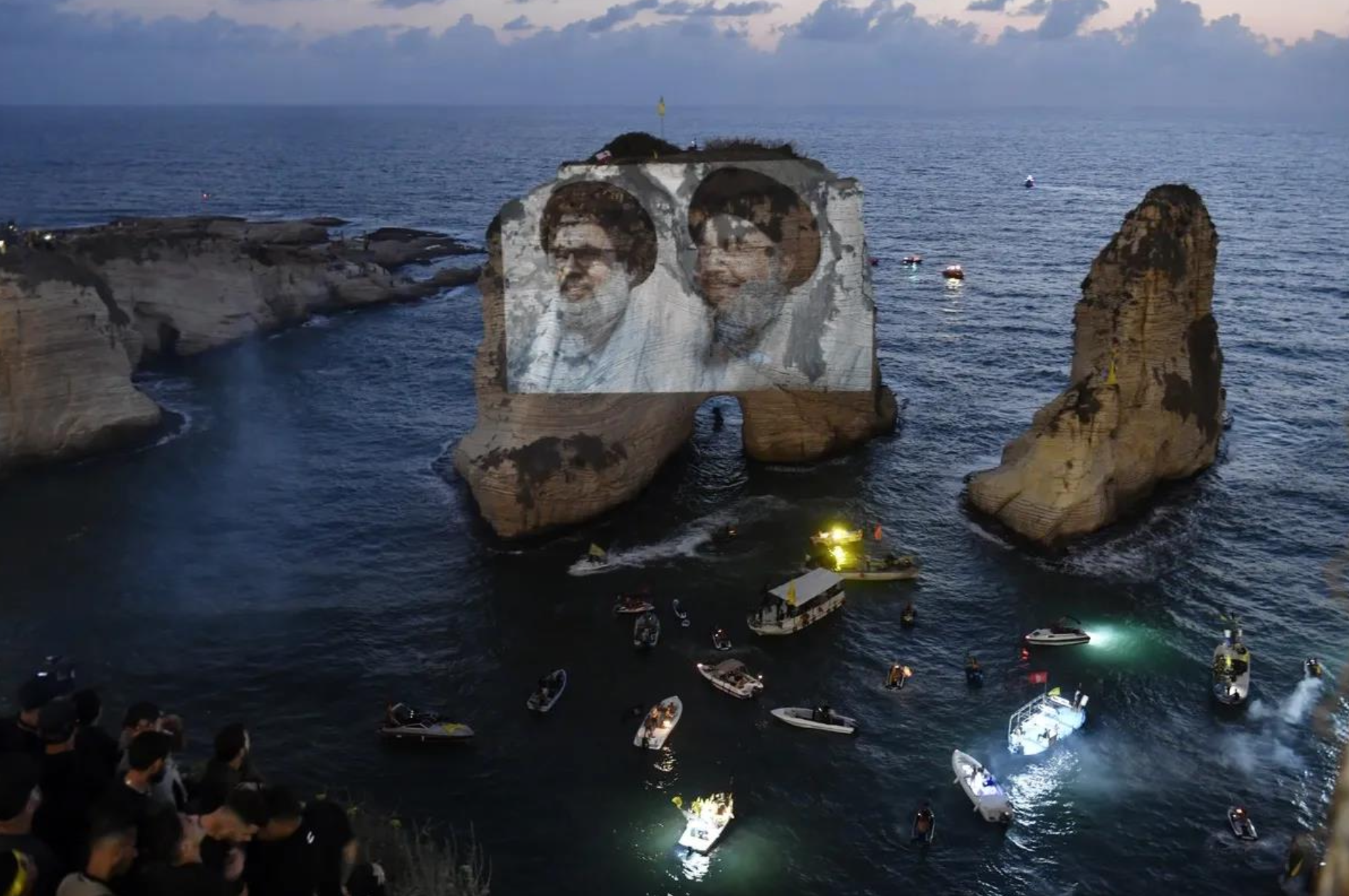
Fig. 1. “Thousands Gather at Raouche in Beirut to Mark Hezbollah Leaders’
Anniversary.” Middle East Monitor, 26 Sept. 2025.
In the afternoon of September 25, 2025, crowds began gathering along Beirut’s seafront Corniche. Thousands of Hezbollah supporters, many waving the group’s yellow banners and Iranian flags, filled the sidewalks facing the Raouché Rock, a site usually reserved for tourists. Loudspeakers blared recordings of Hassan Nasrallah’s speeches, and chants echoed through the streets. Then, as the night settled over the Mediterranean, beams projected the faces of both. Nasrallah and Hashem Safieddine onto the cliff’s pale surface. The display was not a surprise. It defied an official order issued earlier that day by Beirut Governor Marwan Abboud, who had authorized a small rally of 500 people, but explicitly banned any illumination of the landmark. Despite this, the crowd was present in thousands, blocking the Corniche and transforming a national monument into a partisan playground. Internal security forces and the Lebanese Army, tasked with enforcing the ban, were present in limited numbers and did not attempt to intervene. According to Interior Minister Ahmad Hajjar, police were overwhelmed: the laser projectors had been placed “in the middle of the crowd,” making their removal “impossible without risking confrontation.” (L’Orient Today). Others say that any military confrontation could have triggered a Civil War.
By midnight, the projection had become more than a commemoration and was simply a display of impunity. Prime Minister Nawaf Salam condemned the event as a violation of state sovereignty, emphasizing that “no party may act above the law or outside the decisions of the state.” Minister Ahmad Hajjar later confirmed that the permit had been “ignored and exceeded despite being very clear,” and that an investigation had been launched under the supervision of the state prosecutor. He promised that “legal and administrative measures related to the violation of the ban and circular will be taken and followed through to the end.” Returning from New York days later, President Joseph Aoun quickly intervened by defending the army and security apparatus, declaring their operational agendas a “red line” and insisting that “civil peace takes precedence over all other considerations.” He praised both institutions for “fully carrying out their mission,” arguing that without their strategic restraint was indispensable to Lebanon’s “safety and stability” (L’Orient Today). His remarks were widely interpreted as a governmental effort to save institutional legitimacy against mounting criticism that Hezbollah’s coercive power had, once again, effectively defied the state.
For many observers, what unfolded at the Raouché brought back memories of the events of May 7, 2008, when Hezbollah seized parts of West Beirut in response to a government decision to dismantle its private telecommunications network and remove the airport security chief close to the party. Hezbollah fighters clashed violently with militias, media outlets, and political offices associated with the pro-Western Future Movement (Sunni), leaving around 80 people dead (Ismail). The army, under orders to avoid civil bloodshed, remained neutral and allowed Hezbollah to dictate the outcome. What unfolded at Raouché 17 years later followed a similar logic: the army stood aside and the state’s authority was publicly challenged, this time with symbols, not weapons. So, in a way, September 25 was nothing but a “7 May politique”; an assertion of dominance staged through imagery rather than force (Khouri).
Critical Analysis
The events and dynamics detailed above reveal a clear and recurrent pattern: Lebanon’s efforts to reclaim sovereignty have repeatedly exposed the weaknesses of the very institutions meant to enforce it. The August 2025 disarmament plan illustrates this best. By assigning the Lebanese Armed Forces (LAF) the task of bringing all weapons under state control, the government sought to reaffirm its monopoly of force. Instead, the initiative revealed the opposite: an army fundamentally dependent on foreign funding, structurally constrained by sectarian politics, and functionally unable to act without triggering internal conflict. This leads directly to the core analytical question: if the state cannot compel its own primary coercive apparatus to stop a public demonstration, how can it realistically expect this same force to disarm the country’s most powerful non-state armed organization?
Similarly, the state’s reliance on Western military aid to strengthen the LAF inherently subordinates its autonomy to external conditions, while Hezbollah persistently maintains its power by capitalizing on the governance vacuum left by state inaction. The LAF’s structural weakness is clear: with nearly 70% of its $800 million budget dedicated to personnel salaries and a minimal allocation of less than 3% allocated for training or modernization, the army’s operational capacity relies almost entirely on foreign funding (Daher). Thus, the army’s neutrality is not a political choice but rather a necessity: a confrontation with Hezbollah would threaten not only internal cohesion (due to pro-Hezbollah elements within the military) but also the indispensable flow of external support. In reality, Western funding, far from strengthening sovereignty, has redefined it. By conditioning military and economic aid on containing Hezbollah, the U.S. and its allies have transformed Lebanon’s sovereignty into a managed project. The government is encouraged to act against Hezbollah, but only within the boundaries that preserve regional stability and donor interests. Subsequently, the state enforces foreign agendas under the rhetoric of self-determination, satisfying international stakeholders but emptying sovereignty of its primary meaning: autonomy in decision-making.
Internally, the disarmament debate continues to follow sectarian lines rather than unified national ones. For Hezbollah and its supporters, resistance is intrinsically linked to identity and communal survival, serving as a potent symbol of Shi’a agency and pride within a confessional system that has historically marginalized their community. Conversely, for other factions, Hezbollah’s retained military autonomy is the clearest evidence that Lebanon functions less as a sovereign state and more as a territory politically partitioned by competing power centers. As a result, the disarmament question is not primarily a technical issue concerning weaponry, but rather a fundamental contestation over legitimacy: whose vision of the state holds ultimate authority.
Additionally, Hezbollah’s structural autonomy underscores its role as a participant and competitor to the state: a true “state within a state”. Through its social services, media networks, and military infrastructure, Hezbollah performs functions that the state has failed to provide, particularly in Southern Lebanon and the Bekaa Valley. This parallel governance allows the group to claim legitimacy not only as a military resistance movement but as an alternative form of statehood. It exercises the attributes of sovereignty, security, welfare, and representation, without holding the formal title of the state itself. Yet, as argued in The Policy Initiative’s “Lebanon’s Sovereignty Battle Isn’t Just Over Arms”, sovereignty isn’t achieved just by holding weapons but by cultivating legitimacy, institutional capacity, and inclusive governance. The Lebanese government may claim sovereignty in principle, but the presence of Hezbollah’s military wing exposes its inability to exercise it in practice. True sovereignty requires citizens to see the state as both capable and fair, qualities that have been forgotten amid years and years of corruption, sectarian division, and economic collapse (Daher).
Still, the removal of arms could be the first step toward rebuilding that trust. A credible disarmament process, one implemented through transparent governance and with little to no foreign interference, could help restore citizens’ confidence that the state acts for all, not just for certain factions. However, a selective or externally driven disarmament effort risks doing the opposite: reinforcing perceptions of foreign interference and deepening sectarian mistrust. The challenge, then, isn’t simply to remove weapons, but to ensure that doing so strengthens, rather than undermines, legitimacy.
In this context, the Lebanese government’s repeated declarations that “legitimate” weapons must remain solely in the hands of the state” function less as affirmations of power than as aspirational political statements. As such, the gap between sovereignty as principle and sovereignty as practice defines Lebanon’s modern crisis. The resultant dynamic isn’t a complete absence of sovereignty, but rather a fragmented iteration, its authority distributed among powerful domestic factions and foreign actors. Ultimately, Lebanon’s engagement with Hezbollah’s armament reflects a state attempting to assert control without the functional means to sustain it. Moving beyond this managed sovereignty toward genuine self-determination depends not only on disarmament but on rebuilding the institutions and social trust necessary to make sovereignty a tangible reality. Therefore, Lebanon’s response to Hezbollah’s armament not only mirrors its struggle to assert control but establishes that its sovereignty is now conditional, negotiated, and externally sustained – a reflection of a state that survives by balancing its inherent weaknesses rather than overcoming them.
Conclusion
Lebanon’s response to Hezbollah’s armament exposes the contradiction at the core of its political order: a state that claims sovereignty, yet lacks the means to enforce it. The 2025 disarmament plan, the LAF’s constrained role, and the Raouché episode all point to the same conclusion: that the Lebanese state’s authority exists more in discourse than in practice. Sovereignty, in this context, is neither lost nor intact; it is fragmented, divided between formal institutions, armed non-state actors, and external powers whose support sustains but also limits the state’s agency.
This reality carries profound implications for Lebanon’s political trajectory and for regional stability. For individuals, the persistence of parallel power structures entrenches sectarian fragmentation and prevents a unified political will. Regionally, Lebanon’s sovereignty remains conditional on the broader confrontation between Iran and the West, with Hezbollah as both a domestic political player and a proxy within that struggle. The Lebanese-Israeli border reflects this imbalance: as long as Hezbollah retains its arms, Israel will continue to treat Lebanon as a security threat rather than a sovereign actor.
The country’s future, therefore, rests on two diverging paths. If Hezbollah were to surrender its weapons, a scenario that remains unlikely, the Lebanese state could begin to reassert full control over its territory and redefine its regional role, though not without risking a new security vacuum. But if the group maintains its arsenal, Lebanon’s sovereignty will remain conditional, exercised only in spaces where Hezbollah allows it. In either case, the state’s survival will depend less on its ability to command arms than on its capacity to rebuild institutions, restore legitimacy, and negotiate its foreign dependencies.
Ultimately, Lebanon’s struggle isn’t about disarmament alone but about redefining sovereignty itself, from a claim of authority into a durable practice of self-governance.
Works Cited
(ACW), Arab Center Washington DC. “Disarming Hezbollah: Lebanon at a Crossroads.”
Arab Center Washington DC, 22 Aug. 2025, arabcenterdc.org/resource/disarming-hezbollah-lebanon-at-a-crossroads/?utm. Accessed 28 Nov. 2025.
Abi Akl, Yara. “Vingt Ans plus Tard, Qu’en Est-Il de La Résolution 1559 ? - L’orient-Le Jour.” L’Orient-Le Jour, 2004, www.lorientlejour.com/article/1425920/vingt-ans-plus-tard-quen-est-il-de-la-resolution-1559-.html. Accessed 28 Nov. 2025.
Al Jazeera. “Lebanon to Present Hezbollah Disarmament Plan in Coming Days: US Envoy.”
Al Jazeera, 26 Aug. 2025, www.aljazeera.com/news/2025/8/26/lebanon-to-present- hezbollah-disarmament-plan-in-coming-days-us-envoy? Accessed 28 Nov. 2025.
Daher, Joseph, et al. “Lebanon’s Sovereignty Battle Isn’t Just over Arms.” The Policy Intitiative, 2025, www.thepolicyinitiative.org/article/details/466/lebanon’s- sovereignty-battle-isn’t-just-over-arms. Accessed 28 Nov. 2025.
Frankel, Julia, and Abby Sewell. “The Israel-Hezbollah War by the Numbers.” AP News, 27 Nov. 2024, apnews.com/article/israel-lebanon-war-numbers-hezbollah-military-6f1a651ebba0a88fbdb7ca59a57acd1e. Accessed 28 Nov. 2025.
Ismail, Ramzi Abou. “Sixteen Years Later, May Is Still Dark.” Nowlebanon, 9 May 2024, nowlebanon.com/sixteen-years-later-may-is-still-dark/. Accessed 28 Nov. 2025.
Jalkh, Jeanine. “Armes Du Hezbollah : Que Dit Exactement L'accord de Taëf ? - L’orient-Le Jour.” L’Orient-Le Jour, 2023, www.lorientlejour.com/article/1346542/armes-du-hezbollah-que-dit-exactement-laccord-de-taef-.html. Accessed 28 Nov. 2025.
Khouri, Stéphanie. “À Beyrouth, Le « 7-Mai Politique » Du Hezbollah Électrise La Rue Sunnite - L’Orient-Le Jour.” L’Orient-Le Jour, 2025,
www.lorientlejour.com/article/1478850/a-beyrouth-le-7-mai-politique-du-hezbollah-electrise-la-rue-sunnite-.html. Accessed 28 Nov. 2025.
Law, Bill. “Beirut Explosion One Year on: Are Israel and Hezbollah Responsible?” Fair Observer, 6 Aug. 2021, www.fairobserver.com/region/middle_east_north_africa/bill-law-arab-digest-beirut-explosion-anniversary-investigation-hezbollah-israel-news-01771/. Accessed 28 Nov. 2025.
“Lebanese Government Decides to Disarm Hezbollah – Positions of Power Actors.” The Meir Amit Intelligence and Terrorism Information Center, 11 Aug. 2025, www.terrorism-info.org.il/en/lebanese-government-decides-to-disarm-hezbollah-positions-of-power-actors/?utm. Accessed 28 Nov. 2025.
L’Orient-Le Jour. “Larijani : « nous Continuerons à Aider Le Hezbollah » - l’orient-Le Jour.” L’Orient-Le Jour, 2025, www.lorientlejour.com/article/1474628/larijani-nous-continuerons-a-aider-le-hezbollah-.html. Accessed 28 Nov. 2025.
L’Orient Today. “Aoun Defends Army and Law Enforcement after Hezbollah Raouche Controversy.” L’Orient-Le Jour, 2025, today.lorientlejour.com/article/1479073/hajjar-on-hezbollah-raouche-projection-legal-measures-will-be-taken.html. Accessed 2025
Masters, Jonathan. “Lebanon: How Israel, Hezbollah, and Regional Powers Are Shaping Its Future.” Council on Foreign Relations, 2025, www.cfr.org/backgrounder/lebanon-how-israel-hezbollah-and-regional-powers-are-shaping-its-future. Accessed 28 Nov.2025.
Middle East Monitor. Thousands Gather at Raouche in Beirut to Mark Hezbollah Leaders’ Anniversary. 26 Sept. 2025. Accessed 2025.
“Nasrallah Assassination: Qassem Vows Hezbollah ‘Will Remain Armed,’ ‘Ready to Face Israel.’” L’Orient Today, 2025, today.lorientlejour.com/article/1478948/nasrallah-assassination-qassem-vows-hezbollah-will-remain-armed-ready-to-face-israel.html.Accessed 2025.
Robinson, Kali. “What Is Hezbollah? What to Know about Its Origins, Structure and History.” PBS, Public Broadcasting Service, 17 Oct. 2023,
www.pbs.org/newshour/world/what-is-hezbollah-what-to-know-about-its-origins-structure-and-history. Accessed 28 Nov. 2025.
“Sovereignty.” Cambridge Dictionary, dictionary.cambridge.org/dictionary/english/sovereignty. Accessed 28 Nov. 2025.
Travers, Eileen. “Explainer: What Is Security Council Resolution 1701? | UN News.” United Nations, 2024, news.un.org/en/story/2024/10/1155221. Accessed 28 Nov. 2025.
United Nations. “Taif Accords | Peacemaker.” United Nations, 1989,
peacemaker.un.org/en/node/9412. Accessed 28 Nov. 2025.
“What Is Hezbollah?” Council on Foreign Relations, 2024, www.cfr.org/backgrounder/what-hezbollah. Accessed 28 Nov. 2025.