War On Dignity: TheArchitecture of Israeli Humiliation
January 2026, Article written Anonymously
As surveillance drones hover overhead, people record, phones clutched in their trembling hands.Every frame reveals and conceals information, profoundly complicating efforts to establish the very idea of a factual truth. In the Levant, conflict isn’t only conducted in contested sanguinary borderlands, but through competing images and narratives, a struggle over what is seen, mourned, but first and foremost, believed. Analysing media coverage, cultural expressions, and artistic reflections, this article aims to dissect the psychological operations involved in the conflict. The analysis focuses specifically on the, often invisible, wars on dignity and how psychological warfare works to reshape this conflict.
In the Levant, conflict isn’t only conducted in contested sanguinary borderlands, but through competing images and narratives, a struggle over what is seen, mourned, but first and foremost, believed. Analysing media coverage, cultural expressions, and artistic reflections, this article aims to dissect the psychological operations involved in the conflict. The analysis focuses specifically on the, often invisible, wars on dignity and how psychological warfare works to reshape this conflict.
On the morning of the 6th of June 1982, the Israeli Defence Forces (IDF) launched Operation Peace for Galilee. The initial aim was to expel the Palestine Liberation Organisation (PLO) from a 40-kilometer zone north of Israel to protect Israel’s northern borders from rocket attacks. However, the operation quickly escalated: within a week, 60 000 Israeli troops surrounded Beirut and began a siege lasting three months. The intensity of the siege caused about 6776 deaths in Beirut, where the worst bombardment and shelling occurred. The siege itself became a humanitarian catastrophe, according to the ICRC’s annual 1982 report, until the eventual evacuation of the PLO in August. Operation Peace for Galilee was named after its geographic and biblical significance. Galilee, the fertile northern land of Israel and the symbolically divine boyhood home of Jesus, the site of many New Testament miracles was hence invoked in a campaign whose promise of ‘peace’ would unfold through war.
That same morning, sitting in his small apartment overlooking the campus of the American University of Beirut was Lebanese poet Khalil Hawi, famous for his writings of the interstice between collective national and religious hope. But that morning, spiritless, the poet was overcome with what he saw as the collapse of dignity; the shattering of his homeland could not be reconciled with the silence of the Arab world. The previous day, Hawi had confided in his colleagues about the silence and cowardice of Arab leadership, repeating his stoic question: “Where are the Arabs?” Carrying this sentiment home, Hawi staged a final act of civic disobedience – a protest that no camera would capture, but which would haunt the cultural memory of the region. At dawn, he took his own life with a rifle, offering himself as “sacrificial lamb” for his nation and its people. His suicide was neither impetuous nor private, only the utter and most visceral rejection of aggression and internal failures of his society. The, or more so, his ultimate refusal to let shame go unopposed.
Fouad Ajami’s “The Dream Palace of the Arabs” devotes much of its discussion to Khalil Hawi’s descent and death as a starting point to explore the wider fractures in Arab dignity and intellectual life. Ajami's analysis forces us into that often-neglected realm of ‘psychological warfare’, here defined as the dissemination of propaganda designed to undermine the adversary’s will, with other non-violent warfare acts that influence the military discipline of the adversary, as well as with psychological operations (Oxford Public International Law). In the Levant, where identity and religion shape social life, these tactics are more than central; they are vital to any military plan. They include humiliation, misinformation, media manipulation, and fear campaigns. Allowing for the usage of leaflets, social media, and direct messaging to both civilians and combatants as legitimate tactics of war.
This confluence and convergence of psychological and physical violence raises significant questions about the adequacy of international law and ethics in addressing modern warfare. Beyond the crucial need to acknowledge, cover, and condemn physical casualties, the UN’s classification of the conflict as a genocide and humanitarian crisis inherently illuminates the psychological toll and systemic nature of this cleansing. Beyond Gaza, contemporary warfare increasingly wields the invisible weapons of psychological operations (PsyOps). Within this very context, this article must raise a critical, urgent question: to what extent can and should international law adapt to a battlefield that has shifted from the physical to the moral, where psychological humiliation erodes human dignity?
The research hereafter employs Avishai Margalit’s concept of “decent society”, which centres on the elimination of humiliation as its core moral imperative. Margalit defines a decent society as one whose institutions do not humiliate the people under their authority, and whose citizens mutually respect each other’s dignity. He argues that, unlike the ideal of the just society, which accentuates equality and rights, the actual decent society focuses first on eradicating the corrosive experience of humiliation. This emphasis on decency as a foundational social value draws from humane socialist perspectives inspired by Judith Shklar and Isaiah Berlin, who, in his view, make an appeal to humanism understood as the urgent need to live with dignity and respect, freed from all institutional cruelty and degradation. Margalit holds that the irreducible experience of humiliation damages the psychological coherence of persons and so decency ought to be the primary political and ethical goal rather than secondary beneath justice.
Combined with Frantz Fanon's analysis of colonial degradation, this notion becomes fully developed to show how the moral and psychological dimensions of dignity interconnect and are always assaulted under colonial domination. Through his work, Fanon describes how colonialism inflicts deep systemic psychological trauma and dehumanisation. Dignity herein means more than morality; it epitomises violence and cultural erasure. This intersection demonstrates that dignity is not only an ethical idea but a necessary condition for psychological survival.
1.1 Operation Peace for Galilee: The Morning Dignity Died
This section examines how Israeli psychological operations (PsyOps) evolved from tactical necessity into an institutional doctrine of humiliation, a deliberate effort to erode the moral and psychological foundations of Palestinian dignity. It begins by tracing the origins of PsyOps to Operation Peace of Galilee, during which psychological warfare was effectively iron branded on Lebanese society.
The retelling of Khalil Hawi’s suicide is not a mere illustration of transgression; it’s context within the Lebanese invasion of 1982 also marks a pivotal moment in the birth and evolution of Israel’s institutionalised psychological warfare. In fact, PsyOps were born out of the ashes of this conflict.
Israel’s psychological operations have deep historical roots, originally focused on traditional military goals such as lowering enemy morale and disrupting opposition. Before Hezbollah’s emergence, an Iranian-backed Shiite militia that formed after the Lebanese resistance to Israeli occupation, Israel didn’t employ complex PsyOps, focusing primarily on basic leaflets, broadcasts and media campaigns targeted at influencing civilian support and opinion. These efforts later developed into more systematic campaigns at burning messages into the enemy’s consciousness. However, the rise of Hezbollah became more than a military opponent, it was an ideological and social movement rooted deeply in Lebanese society – a form of resistance unfamiliar to traditional warfare. As such, this new, unforeseen realm of opposition forced Israel to adapt, hence, its psychological warfare evolved into an integral strategy of military tactics. PsyOps became braided into the military fabric of Israel, it became a central element of Israel’s doctrine to confront this new threat, whose strength relied on its popularity.
The 2006 Lebanon war was a critical inflection point in the history of such operations. The conflict exposed serious gaps in Israel’s military preparedness against guerrilla and proxy warfare. Hezbollah’s resilience, using defence and rocket attacks, exposed the illusion of Israeli superiority. In the wake of this, Israel invested heavily in PsyOps capabilities, seeking to undermine Hezbollah through multi-channel information campaigns that extended beyond the battlefield and evolved into a broad effort to influence public opinion and political decisions. In her study of 2020, Felicia Lindqvist revealed that the IDF based the development of their own campaigns on the principles of communication studies and U.S. PSYOs' manuals, and the intended targets of these efforts included the leaders and followers of the Hezbollah movement, as well as Lebanese society in general.
However, the real purpose of such operations remained the weakening of the charismatic leadership of Hassan Nasrallah, the secretary-general of Hezbollah, since 1992. Nasrallah had turned the Hezbollah movement from a mere armed faction into a strong political, armed, and social force within Lebanese society. Notably, the weakening of this leadership was manifested by the aerial distribution of satirical leaflets that depicted Nasrallah as coward, selfish, and self-centred, hiding behind civilians. These efforts sought to exploit dissonance among Hezbollah’s supporters by personalising blame, thus abrading collective identity in its support – a difficult yet essential task for any psychological tactic. However, scholars like Ryan Schleifer acknowledge that these campaigns have yielded limited success at best. Hezbollah’s political power and militant capabilities remained strongly cemented in the soil despite Israel's attempts to depot it.
Elaborating on the specific sensitivity of satire, Diana Moukalled wrote for Al-Shara al-Awsat that satire directed at Nasrallah had always resulted in fierce reactions in the past. In Lebanon, Nasrallah occupies a near-sacred status (among his supporters), effectively venerating him as a “godly” category where mocking him becomes socially and politically unacceptable. For instance, a 2013 satirical Lebanese show poking fun at Nasrallah sparked widespread protests and roadblocks, showing that Hezbollah heavily relied on its carefully constructed aura of charisma and infallibility.
Satire immunises audiences against “heroes” and ideological indoctrination; this, in turn, counters the sanctification of figures like Nasrallah. Moullaked further highlights how, before the Arab Spring, satire in Lebanon was more restrained and submissive to political calculations, avoiding direct mockery. As social media developed, so too has the intensity of political unrest; satire is now more prone to taking a braver, fiercer approach.
Thus, Israel's use of satire in its PsyOps ridicule campaigns against Nasrallah fits within a greater regional context in which humour functions not strictly for entertainment purposes alone but is a strong ideological antidote as well. Beyond targeting leadership, Israeli PsyOps focused heavily on seeding divisions within Lebanon. Their first attempt was to enhance discord among Shiite factions or, at least, between Hezbollah and other political actors. These wedge tactics remained a simple reflection of Israel’s insatiable desperation to destabilise Lebanese internal cohesion.
1.2 The Stench of Control
Physical degradation, particularly through the manipulation of the senses, has become one of the most intimate forms of psychological warfare. IDF attacks have relentlessly undermined the dignity of the Palestinian population, notably through the deliberate, targeted destruction of critical hygiene and sanitation infrastructure. This tactic aims to achieve systematic degradation, thereby equating their perception of the population with the subhuman treatment being inflicted upon them.
Israeli soldiers have been repeatedly observed spraying “skunk water”, locally known as “bad breath” – an artificially concocted noxious liquid with a stench far worse than raw sewage water– on Palestinian homes and against protesters. The Journal Sage defines it as a crowd control tool originally developed by the Israeli Police to disperse Palestinian protest. Created by an Israeli company named Odortec, the first usage of this “water” in 2008, was reportedly a means to disperse protests in Palestinian villages. Yet since then, the use of the weapon has expanded in scope, effectively replacing other more overtly violent techniques such as rubber bullets and tear gas. This marks the first degree in a plan of psychological and social humiliation inasmuch as the usually hidden processes of control become more visible.
This is achieved through the employment of military-combat vehicles that spray the said liquid into the residents’ areas; the liquid has a foul smell that persists for days. On October 24 2025, one of the residents from the city of Jerusalem described the effects of an incident similar to the one above when he said: “You cannot imagine how disgusting this water smells, and it only goes away after many days. If it touches your body, you must hide for at least a week”. Beyond the physical discomfort of the stench, exposure to this liquid has reportedly caused serious health issues, including nausea, skin irritation, and respiratory issues. These adverse effects are bizarre given the ingredients of this ‘water’ are, according to their manufacturer, from "100% food-grade ingredients" and are "100% eco-friendly - harmless to both nature and people". Yet, irrespective of its stated composition, the liquid’s function in this context is clearly that of a pesticide: it treats the Palestinian population as vermin, reinforcing their dehumanisation, with the explicit aim that they internalise this degrading perception.
Not only is this an act of clear humiliation, an attempt to subordinate an entire population to another one’s ego, but it has also affected the closure of shops and displaced homes during the duration of the lingering inhumane odor. The tactic not only inflicts physiological harm but also disrupts socioeconomic continuity, extending its harm from the individual to the collective.
One of the most severe and recent attacks occurred in October 2025, when Israeli troops set fire to the Sheikh Ailin sewage treatment plant in Gaza City as part of a military drawdown following a ceasefire agreement. This plant was the last functional treatment site, serving approximately 700 000 residents out of Gaza's 2 million population. Its destruction was described by Monther Shoblaq, the director general of Gaza’s Coastal Municipalities Water Utility (CMWU), as a blow that could push Gaza’s wastewater system to “point zero” – a clear attempt to exterminate all forms of life on the strip. This targeted arson happened on the night of October 9 2025, and was reportedly part of a broader spree of destruction by Israeli soldiers who called it their “final touches”. The same spree included setting fire to food supplies and homes. Satellite images taken in May 2025 showed the plant was partially intact, with plans in place to restart operations once fighting ceased.
Shoblag noted that the Sheikh Ailin plant, already one of Gaza’s oldest facilities, had a design capacity of 75 000 cubic meters per day and was the only remaining plant capable of treating sewage from Gaza City after the earlier destruction of the Central Gaza Wastewater Treatment plant near Bureij during buffer zone establishment operations by Israel. The systematic destruction of said sewage infrastructures was part of a declared Israeli strategy to render treatment facilities inoperable. In March 2024, Israeli foreign minister Gideon Sa’ar criticised the rehabilitation of these infrastructure projects, while Itamar Ben-Gvir lauded the power blackouts meant for these infrastructure sites. Such statements combined create a context where the destruction of infrastructure is also legitimate, part of the justified ideological line towards increasingly draconian treatment of Palestinians.
The effects of these assault actions are devastating: more than half of the population is living with direct exposure to sewage or fecal matters within 10 meters of their homes. According to the Humanitarian Office of the UN (OCHA), 57% of households reported that “at least one family member was affected by skin diseases due to exposure to sewage water.” More than 700 000 meters of sewage pipes have been knocked down, as stated by the Gaza Government Media Office, “destroyed in the last two-years period of conflict.”
In Gaza, the stench of control is no accident. The lingering mark it leaves behind is designed to degrade and terrorise an entire people.
1.3 The War on Morale
Attacks against communal resilience operate on two distinct planes. Where the systematic destruction of hygiene assaults the body, efforts to fracture collective morale assault the spirit, using an orchestra of fear, confusion, and exhaustion. Morale, however, is a blurry, almost elusive concept, (hence why, much like art) its documentation often requires indirect representation. To illustrate this, consider photographic journalism.
How do you hold in the shadow and light of a single photograph the arguments of generations? How do you portray morale – a person or group's confidence, enthusiasm, and discipline at any given time?
1967 Jean Mohr's photograph of a Palestinian boy from Ramallah does just that. The photograph was taken several days after the Six-Day War and depicts an Israeli officer considering an ICRC proposal in Kalandia, a village between Jerusalem and Ramallah. The officer is sat visibly focused on his piece of paper, while, behind him, a glass window separates him from a boy. This glass window doesn’t signify a physical barrier but more so, a metaphorical borderland from which the boy cannot escape, which encloses him. This young Palestinian boy is looking into the camera that captures him, his eyes visibly carrying so much weight for such a little boy. He stares right back at the world that is slowly chipping away at him, with his morale encoded in his literal retina.
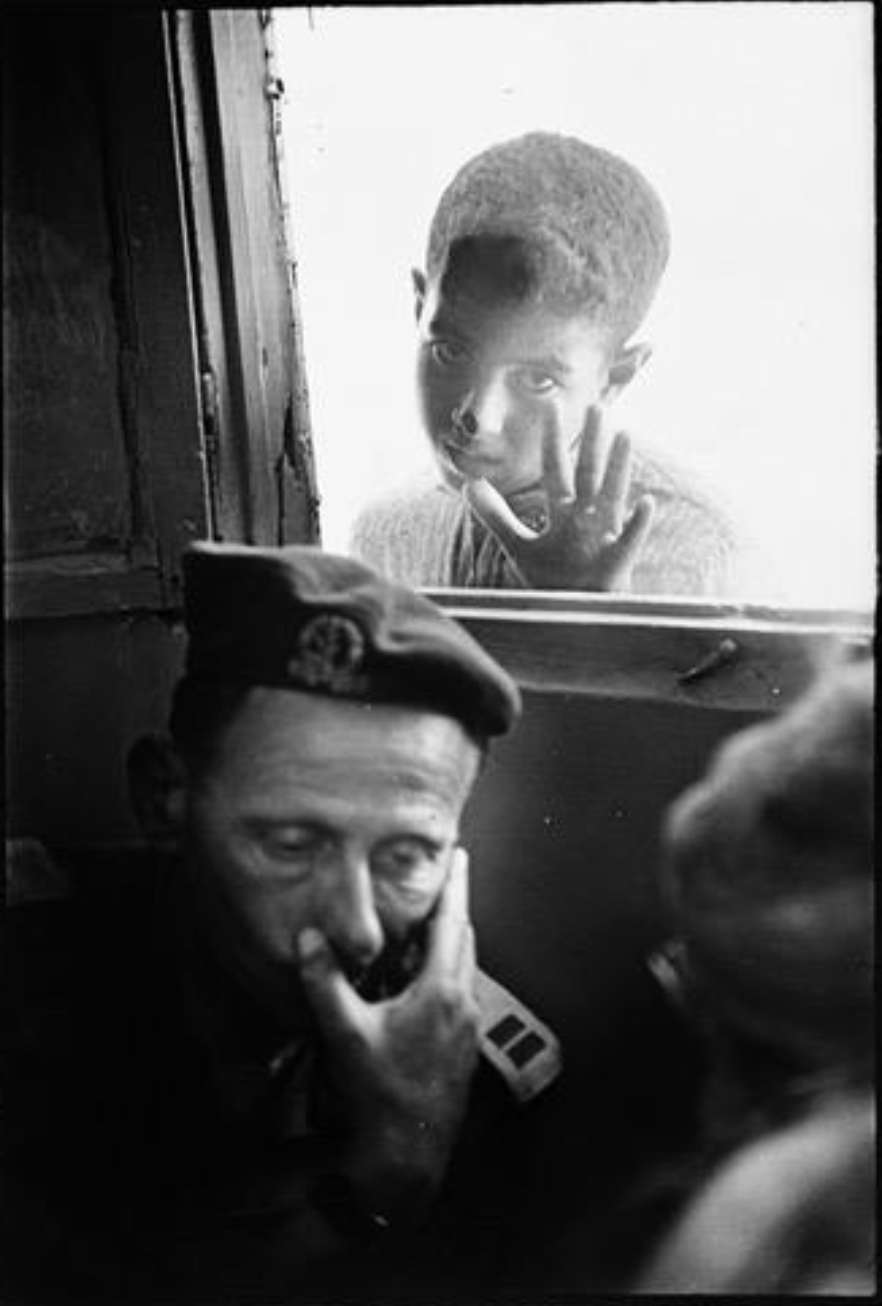
International Committee of the Red Cross (ICRC). “Arab-Israeli Conflict of 1967: Ramallah, Kalandia Photograph by Jean Mohr.” Archives.https://avarchives.icrc.org/Picture/45175
58 years ago, to this day, this boy’s eyes deeply compel any viewer in all their mercifulness, compassion, and empathy. It exposes the intense tension between the observer and the observed. This silent, watchful presence symbolises not only the chronic vulnerability of such deeply cemented people in their land but also the enclosure and restraint experienced by them, trapped behind both the metaphorical and literal glass wall. The photograph is a testament to the decade-long erosion of Palestinian morale.
The ongoing conflict is the perfect example of this, the IDF deployed drones-quadcopters over Palestinian neighbourhoods broadcasting distressing sounds like babies crying or women screaming. The intent was clear: to spark anxiety and draw people outside where they would then be targeted by gunfire. A resident, who requested anonymity, reported to the Euro-Med Monitor team: “We were sitting at night when we heard voices of girls and women screaming: ‘Come, help me, I am injured!’ We went out to find out what was happening. No women were found, but we were directly targeted by a quadcopter drone.” It's sleeplessness, confusion, and terror that slowly abrade the resilience of a community in tactics like this one.
Today’s manipulative tactics employed by the IDF are only a testament to the IDF’s evolution of strategies honed over decades of conflict. One such tactic is the use of false ceasefire announcements. This strategy is not new, during Operation Cast Lead (2008), for instance, Israeli broadcasts continuously hinted at a temporary ceasefire. The obvious aim was to encourage militants and civilians to emerge from hiding. But once the lull was accepted, massive airstrikes followed with devastating effect. Modern applications of these methods continue this legacy, showing the cold, tactical, deadly sophistication of the IDF’s PsyOps.
1.4 The Media Front
Nowadays, the global balance of power has shifted from coercion and toward attraction and persuasion, making a nation’s image its most valuable currency. This “soft power”, as Harvard scholar Joseph Nye frames it, operates not through force or payments but by shaping preferences and managing perceptions on the international stage. In the Levant, this battle for influence is fought in an ever-ending media war – the ultimate arena for commodifying and shaping a national brand on a global scale. Israel’s approach to media and propaganda forms a pivotal front in its psychological operations, tightly interwoven with its military and political strategies.
In fact, Israel’s state apparatus has developed highly sophisticated media response structures, coordinated primarily through the Israeli Foreign Ministry, IDF Spokesperson's Unit, and the Ministry of Strategic Affairs. This counter-propaganda effort, particularly across X (formerly called Twitter), Instagram, and Telegram, greatly accelerated since October 7 2023. IDF strategy uses digital assets, infographic blitzes, and coordinated hashtag campaigns to frame Hamas attacks as a threat, to which subsequent Israeli military action serves as a legitimate, necessary defence. In response to the global surge in pro-Palestinian sentiment, Israel has increased its spending on digital public diplomacy, deploying English-speaking influencers and even training conscripts for online engagement. The National Public Diplomacy Directorate explicitly cited the need to “win the social media war” as crucial for ensuring policy legitimacy, a goal which relies almost entirely on securing international support. Following October 7 2023, Israeli governmental spokespersons and allied media repeatedly amplified reports of “systematic mass rapes” purportedly committed by Hamas. These allegations, most notably circulated by Israeli officials, including Gali Bahavar-Miara, Attorney General, and publicised by media partners were rarely substantiated by independent investigations as of late 2023. The repetition of these widespread narratives functioned less as neutral news but more as “moral weaponry”, says Eyal Weizman, a tactic aimed at legitimising disproportionate retaliation as righteous violence. This fits more broadly into the deployment of “soft power” in attempting to portray Israelis as perpetual victims of predatory violence. In late 2023, to exemplify, President Isaac Herzog and Foreign Minister Eli Cohen made prominent appeals at the United Nations, referring to “families shattered by barbarism”.
Moreover, Israel’s broadcasting of Prime Minister Benjamin Netanyahu’s speeches directly into Gaza, via hijacked FM frequencies and loudspeaker trucks from November 2023 onward, constitutes yet another explicit psychological operation. These incidents, documented by Al Jazeera and local Gazans, were designed as “humiliation rituals”, a term used by Israeli journalist Amira Hass to describe the subjugation inflicted by the Israeli political order.
As a means of discrediting the popular belief of an internal indivisible Israeli state, in late 2023 and early 2024, numerous protestors, including reservists and youth, were detained for acts like burning or defacing Israeli passports and refusing conscription. Said actions were later diminished or scrubbed from mainstream media by authorities, fearful of the crackling of their well-built image. Whistleblowing incidents, viral videos documenting police violence, and international rights group reports further expose attempts to repress the portrayal of internal division.
Finally, while the Israeli state pursues a cohesive national image, Israeli soldiers’ appearance on adult content platforms such as OnlyFans since October 10 2023, exposes a deep tension: individual acts of self-branding both amplify and undermine official national messaging. These images, which often combine military uniforms with explicit sexual content, create a surreal juxtaposition of war and erotism. By portraying “bright and clean bodies, free of any wounds or signs of involvement in war”, these digital commodities effectively sanitise the conflict’s brutal realities for consumerist consumption.
Israeli scholar Daniel Monterescu refers to such phenomena as “brand spill”; a counterproductive imagery that commodifies not only the IDF’s image but also the ‘Holy Land’ itself as the backdrop of obscenities. The sanitised, sexualised presentation of “clean” soldiers, starkly contrasting the brutal dimension and tragedy of the conflict, decontextualises violence and creates confusion around narratives of heroism and victimhood. Ultimately, this inadvertently complicates Israel’s strategic effort to market itself as a besieged yet moral actor. Exemplified by Amichai Attali, Israeli journalist, who posted on X: “I would never, ever publish a video that makes IDF soldiers look bad, even when they did something wrong, out of the understanding that it could tarnish our image in the eyes of the entire world.”
1.5 A Siege of Necessity
Throughout history, sieges have tested not only military strategy but the boundaries of human endurance. When access to food, water, and medicine becomes a weapon, survival itself becomes an act of resistance. From Leningrad to Sarajevo to Gaza this is ever more present. Gaza’s current devastation echoes this ancient logic of warfare - one where deprivation can be as cruel as the bombs falling from the sky.
Under a relentless blockade and repeated military assaults, Gaza's population suffers a slow death of deprivation, not only of food and water but also of dignity. By August 2025, the Integrated Food Security Phase Classification officially declared famine conditions across Gaza. Over 640 000 people suffer from catastrophic food insecurity in Gaza, whose characteristics are widespread starvation and preventable deaths. Another 1.14 million are experiencing emergency food insecurity. Furthermore, an estimated 98% of Gaza's cropland has been destroyed due to continuous bombardments. Fuel shortages have paralysed cooking and heating, medical supplies are scarce, and food prices are extremely high, rendering life in Gaza harder than ever before. While there have been increases in humanitarian aid, such aid is widely recognised to be grossly insufficient and erratically delivered.
While controlled by Egypt from 1948 until 1967, Gaza was occupied during the 1967 Six-Day War by Israel, initiating Israel's direct military control in the strip. Though the Oslo Accords in the 1990s sketched some kind of framework for Palestinian sovereignty, the violent and politically fraught takeover by Hamas (2007) radically changed the context for the entire Levant. Israel and Egypt imposed a strict blockade, which has since then defined Gaza's contemporary humanitarian crisis.
The Israeli blockade is intended to hinder weapons and militant activity of Hamas leaders, an organisation which Israel, the U.S., and the EU describe as a terrorist organisation. External measures, such as land, air, and sea restrictions, severely limit the flow of goods and people in and out of Gaza. For instance, commercial crossings such as Karni were closed, maritime fishing limits drastically reduced, and imports of many materials were subject to special permits. All these policies achieve what's wanted more than ever: the strangulation of the Gaza economy and the effective isolation from the outside world.
Egypt's parallel role dramatically shapes the siege in Gaza. The Rafah crossing, the only Gaza border abutting a state other than Israel, was closed following Hamas' takeover in the middle of 2007. Egypt's closure of the said border was influenced by internal Sinai insurgencies, fears of militant spillover, and a broader policy to isolate Hamas. This desire was, all along, rooted in Egypt's historic suppression of the Muslim Brotherhood from which Hamas ideologically descends. Egypt, under President Hosni Mubarak and continuing further on under his successors, has maintained near total closure.
In addition, Egypt actively destroyed smuggling tunnels beneath its border with Gaza that had served as lifelines for goods blocked by Israeli restrictions. Egyptian policies were also linked to U.S. military aid conditions, pressuring Egypt to assist in restricting Gaza’s supply lines as part of broader counterterrorism cooperation.
The culmination of all these events has been near-complete isolation, which has not only been physical deprivation but has also produced catastrophic mental health effects.
1.6 Desecration of Sex(uality)
Malak Mattar, a Palestinian artist, specialises in painting visceral and confrontational portrayals of the trauma inflicted on women by war and occupation, with sexual violence as a central theme. Her work depicts the fierce gazes of women amidst rubble, as well as the invisible scars carried from this violence. Mattar stresses that art’s purpose here is to disrupt, to confront the moral void left by such brutality, rejecting any artistic approach that caters to the audience’s desire for the comfort of ignorance.
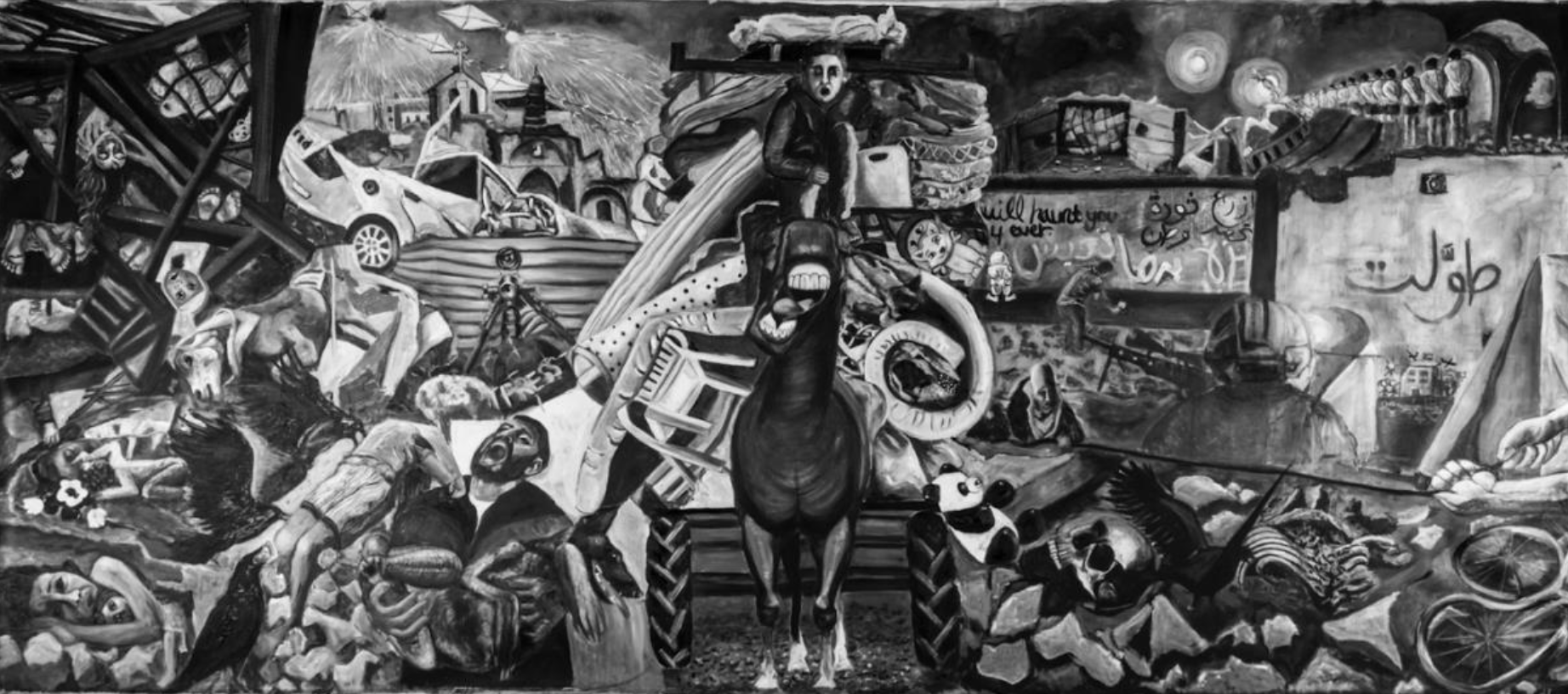
Malak Mattar, "No Words," oil on primed linen, 218 x 485 cm, 2024 (courtesy of the
artist). April 26, 2024 https://themarkaz.org/malak-mattar-no-words-only-scenes-of-ruin/
One example of such psychological warfare operations targeting sexuality is “Operation Defensive Shield”. Initiated on March 30 2002 during the Second Intifada, Defensive Shield marked one of the Israeli military’s largest incursions into the West Bank, targeting major Palestinian cities such as Ramallah, Jenin, and Nablus. The IDF imposed long curfews and a heavy siege, restricting tens of thousands of Palestinians to their homes while they continued to bomb and arrest.
One example of such psychological warfare operations targeting sexuality is “Operation Defensive Shield”. Initiated on March 30 2002 during the Second Intifada, Defensive Shield marked one of the Israeli military’s largest incursions into the West Bank, targeting major Palestinian cities such as Ramallah, Jenin, and Nablus. The IDF imposed long curfews and a heavy siege, restricting tens of thousands of Palestinians to their homes while they continued to bomb and arrest.
As a calculated move within this operational context, Israeli troops seized control of several local Palestinian television stations in the West Bank city of Ramallah, among them Al-Watan, Ammwaj, and Al-Sharaq. Their action was immediately followed by the non-stop, two-day long broadcasting of hardcore pornography, utilising captured media channels as a deliberate tactic of psychological offense.
This was more than a simple military occupation that we could have previously seen; it became an aggressive attack against the cultural and social identity of Palestinians. Television in any society represents a critical space for cultural transmission and community, yet these stations were turned into instruments of psychological terror. The forced imposition of explicit sexual content into homes violated deeply ingrained social and religious norms.
As reported by Rita Giacaman, then technical director of one of the hijacked stations, the seizure disrupted children’s programming and replaced it with the pornographic films, which exacerbated the anguish already experienced by the families trapped in the curfew. Such an act, documented firsthand by Giacaman, was reported in the New York Times by James Bennet on March 31 2002. This article is one of the only two report of this, exemplifying that the deliberate infliction of psychological harm often goes unreported in mainstream media. This limited documentation and, as a result, awareness, stems from Israeli military’s control over media during incursions and restrictions on foreign journalists who were barred from reporting directly from Ramallah. This orchestrated concealment of PsyOps tactics denies the world a full and genuine account of the suffering endured, opacifying true human cost. How many operations like this one, or worse, go undocumented?
The broadcast of hardcore pornography was a form of symbolic violence that not only infiltrated intimate spaces but also undermined the Palestinian social fabric at a time when the resilience of the community was vital. It instilled a sense of contamination and shame that violated the sanctity of homes. Such sexualised symbolic aggression triggers layers of trauma by converting even the most private areas into yet another arena of domination where children can’t be protected anymore – the weaponisation of taboos to fracture the resilience of a people.
Human rights scholars have identified the Ramallah broadcast as a distinct example of war’s weaponisation of sexuality. It reveals how sexual violence and sexualised imagery operate together; physical sexual violence, such as documented rapes and torture, is convoluted with the symbolic assaults on identity. The psychological ramifications of this strategy are, in fact, multifold. Forced exposure to pornography broadly triggers stigma, shame, and humiliation. One Ramallah resident summed up the experience: "Our children were forced to see things that violated everything our culture holds sacred… It was an invasion of our homes, our minds, and our dignity".
Matching and compounding the symbolic sexual violence of the operation were physical abuses within other contexts, like for instance the Israeli military detention system.
In August 2024, obscene, shocking footage was leaked from the Sde Teiman prison in the Negev desert, where Palestinian detainees had been subjected to severe sexual torture. The leakage to the press depicted Israeli soldiers gang-raping a blindfolded Palestinian prisoner in what became known as one of the most egregious cases of institutional sexual violence emerging from the conflict. Five soldiers beat the detainee, dragged him, stepped on his body and tasered him. According to the indictment, the victim suffered from extensive physical trauma ranging from a ruptured bowel, fractured ribs, a punctured lung requiring surgery, and extensive anal trauma after being stabbed in the buttocks.
The leakage of the said video was approved by then IDF chief legal officer Maj Gen Yifat Tomer-Yerushalmi, who later resigned in October 2025 amid an unprecedented wave of political and legal backlash and controversy. Tomer-Yerushalmi stated she released the footage to combat what she described as false propaganda against military authorities, specifically to counter claims that reports of detainees were fabricated, and to defend the integrity of the military’s law enforcement. She emphasised in her resignation that there are actions which must never be taken, even against the vilest of prisoners, and remorsefully regretted that this principle was no longer universally accepted within the system. Timer-Yerushalmi approved the release of the material following immense pressure and a wave of harsh public criticism against her department for pursuing the investigation of abuse at Sde Teiman. After resigning, Tomer-Yerushalmi was placed under criminal investigation, faced formal arrest and was charged with obstruction of justice and with the unauthorised leak of classified materials. She subsequently went missing for several hours before being found alive and later got hospitalised following a reported suicide attempt. Her phone was then retrieved and handed in to the authorities by fellow civilians.
This forms part of a larger trend that soldiers are impermeable, “even sacred”, Haaretz journalist Tom Levinson told Roy Schwartz in the Guardian. “It feels as if they should be able to do whatever they want, and there shouldn’t be any repercussions.” This quote takes all its sense when you look at later events, like for example a 21-minute interview with four of the five guards on Channel 11 News. They were portrayed as the “real victims” in the story, framed and set up for something they had never done. Tomer-Yerushalmi’s resignation goes to show that Israeli institutions allow sexual violence to be used as a tool of control and humiliation within a military justice system that shields its perpetrators. Medical and paramedical testimonies from detainees, including survivors like Ibrahim Salem, expose a pattern of sexual torture. These abuses, far from being isolated incidents, have been acknowledged by the United Nations and human rights organisations as a deliberate component of Israel’s occupation strategy, weaponising sexual violence/torture to dehumanise Palestinians.
The experience of N.A., a 42-year-old Palestinian woman detained in November 2024 while crossing a checkpoint in northern Gaza, explicitly bares the depth of the institutionalised practice and the soldiers’ strong feeling of impunity. The Palestinian Centre for Human Rights describes this as an “organized and systematic practice”. “I was left naked the whole day in the room, where I spent three days”, she testified. She recalled being cuffed to a metal bed and being beaten and raped blindfolded. “I cannot describe what I felt; I wished for death every moment. After they raped me, I was left alone in the same room, hands still cuffed to the bed and without clothes for many hours”; “On the third day, I remained without clothes while they looked at me through the door slit and filmed me. One soldier said they would post my photos on social media.”
This system of terror, which seems to be the only appropriate word to describe the feeling of the detainees, does not target only females; male detainees are them too subjected to such psychological torture. The centre also documented M.A, aged 18, arrested by Israeli forces near the Gaza Humanitarian Foundation aid distribution centre testified being assaulted and raped, explaining that soldiers “ordered me and six other detainees to kneel, and they raped us by inserting a bottle into the anus.” As a result, the PCHR demanded for “concrete measures to pressure Israel to release all Palestinians arbitrarily detained, to disclose the fate and whereabouts of all forcibly disappeared persons, and to allow the International Committee of the Red Cross immediate and unrestricted access to all detention facilities.” The centre also further demanded that the international community “take immediate action to end the systematic policy of torture and enforced disappearance against Palestinian detainees.”
Considering the above part, in such a ‘Holy Land’, it is shameful and revealing that sexual violence is so openly wielded as a legitimate tool of state power and warfare. To name these atrocities explicitly is not only an act of bearing witness, of facing the undeniable; it is a necessity to pierce through the silence that enables this terror to persist unchallenged; women and men alike, Palestinian and Israeli alike. These operations’ purpose extends beyond the physical injuries inflicted; it aims to shatter the victim’s sense of self. The body can be sutured, the wounds bandaged, but the mind, violated at gunpoint, bears a rupture that cannot be surgically repaired.
Conclusion:
In the Levant, the battleground, as we have seen, extends far beyond concrete walls and weaponry, it penetrates the very core of human dignity. As drones, indeed, hover overhead and families huddle in fear, the systematic psychological degradation inflicted upon the Levantine people transforms the conflict into a battle over the soul of a nation. Israeli measures of humiliation, from displacement orders to relentless surveillance, aren’t just acts of control, with an ultimate aim of settling in the land, they are assaults on the very principle of the fundamental right of living with dignity.
To conclude this article, we must face one monolithic truth: our security is intertwined, “as intertwined as the fears and nightmares of our children” (Madrid Peace Conference of 1991). This is the core of the conflict, not land or power or money or even legitimacy, but of shared suffering. Until global consciousness awakens to said reality, until we are brave enough to look outside the little cocoon of comfort that remains the screen we chose to look, or not, at news, we will sustain its tragic toll. Until then, the echoes of humiliation, fear, and pure hatred will haunt the Levant’s future; the war on dignity being, alas, a war on humanity.
Bibliography
Abdulsalam Fayez and Rania Abu Shamala, “Freed Gazan Woman Reveals Sexual
Torture in Israeli Prisons,” Anadolu Agency, November 12, 2025,
https://www.aa.com.tr/en/middle-east/freed-gazan-woman-reveals-sexual-torture-in-
Ajami, Fouad. The Dream Palace of the Arabs. Vintage Books, 1998.
Al Jazeera. “Analysis: Propaganda, Deception, and Fake News in the Gaza War.” October
14, 2023. https://www.aljazeera.com/news/2023/10/14/analysis-propaganda-deception-
Amnesty International. “Israel: Palestinians from Gaza held in secret detention describe
torture - new testimonies” https://www.amnesty.org.uk/press-releases/israel-palestinians-
Antidox.fr. “Situation in the Middle East: Information Warfare in the Age of Social
Media.” October 18, 2023. https://www.antidox.fr/en/2023/10/19/situation-in-the-middle-
east-information-warfare-in-the-age-of-social-networks/?cn-reloaded=1
Bennet, James (31 March 2002). "MIDEAST TURMOIL: THE FIGHTING; AS
ISRAELI TROOPS TIGHTEN GRIP, BUSH SAYS ARAFAT MUST DO MORE TO
AVERT NEW TERROR ATTACKS". New York Times. Retrieved 19 November 2025.
Bergman, Ronen. “Israel's Psychological Operations in the Lebanon War.” New York
Times, July 23,2006.https://www.nytimes.com/2006/07/23/world/middleeast/23psych.html
BBC News. “Hamas: Who Are They?” April 7, 2022.https://www.bbc.com/news/world-
BBC News. “Israeli Military's Ex-Top Lawyer Arrested Over Leak of Abuse Video.”
November 3, 2025.https://www.bbc.com/news/articles/cy0kpd97qqko
B’Tselem. “Operation Defensive Shield: Soldiers' Testimonies.”
Brennen, L.M. “Hezbollah: Psychological Warfare Against Israel.” Defense Technical
Information Center, 2009.https://apps.dtic.mil/sti/pdfs/ADA505646.pdf
Civil Protection and Humanitarian Aid Operations. “IPC Global Initiative - Special
Snapshot.” August 2025.https://civil-protection-humanitarian-aid.ec.europa.eu/news-
stories/news/statement-commissioner-lahbib-gaza-famine-2025-08-22_en
Dazed Digital. “The Palestinian Artist Channelling ‘Rage, Love and Hope’ into Her
Paintings.”https://www.dazeddigital.com/artsandculture/article/20022/1/ten-of-the-best-
. Defensa.gob.es. “Cognitive Warfare in the Gaza Strip and West Bank
Conflict.”.https://www.defensa.gob.es/documents/2073105/2320887/la_guerra_cognitiva_
2025_dieeeo80_eng.pdf/0acae897-eb13-a780-a400-ba54c4705355?t=1759749543232
Electronic Intifada. “The Effects of Israel’s Operation Defensive Shield on Children.”
March 2025.https://electronicintifada.net/content/effects-israels-operation-defensive-
European Commission Joint Research Centre. “Food Crises Impact Report
2025.”https://joint-research-centre.ec.europa.eu/jrc-news-and-updates/food-crises-12-
million-people-suffer-catastrophic-conflict-driven-hunger-2025-2025-09-16_en
Fanon, Frantz. Black Skin, White Masks. Translated by Charles Lam Markmann. New
York: Grove Press, 1967. Accessed November 9, 2025.
Fisk, Robert. Pity the Nation: Lebanon at War. Oxford University Press, 2001.
FutureUAE. “How AI and Technology are Shaping Psychological Warfare in Middle East Conflicts.” January 14, 2025.https://futureuae.com/enUS/Mainpage/Item/9941/war-of-the-
mind-how-ai-and-technology-are-shaping-psychological-warfare-in-the-21st-century
Human Rights Watch. “Israel: Military Sexual Violence and Psychological Torture of
Palestinian Detainees.” July 2024.https://www.hrw.org/news/2024/07/23/israel-detainees-
Human Rights Watch. “Israel: Use of Skunk Water as Crowd Control.” January
2020.https://www.hrw.org/news/2020/01/17/israel-use-skunk-water-crowd-control-raises-concern
Human Rights Watch. “World Report 2025: Israel and Palestine.” March 23, 2025.
https://www.hrw.org/world-report/2025/country-chapters/israel-and-palestine
Integrated Food Security Phase Classification. “Famine Confirmed in Gaza Governorate,
Projected to Expand.” ReliefWeb, August 22, 2025.https://reliefweb.int/report/occupied-
palestinian-territory/gaza-strip-famine-confirmed-gaza-governorate-projected-expand-1-
International Committee of the Red Cross (ICRC). “Arab-Israeli Conflict of 1967:
Ramallah, Kalandia Photograph by Jean Mohr.”
International Committee of the Red Cross (ICRC). “ICRC/Lebanon, Sabra and Chatila.”
ICRC, January 31, 2004 https://casebook.icrc.org/case-study/icrclebanon-sabra-and-chatila
Israeli Ministry of Foreign Affairs. “National Public Diplomacy Directorate: Winning the
Social Media War.” 2023.
Jerusalem Center for Public Affairs (JCPA). “The Palestinian Perceptual War Strategy
Against Israel.” October 4, 2025.https://jcpa.org/psychological-asymmetry-post-october-7-
Kalagy, T., et al. “Psychological Distress Among Israelis During Crisis.” ScienceDirect,
2025.https://www.sciencedirect.com/science/article/pii/S0165178125001398
Kalliopi Chainoglou, “Psychological Warfare” Oxford Public International Law. August
2016, Accessed 11 November 2025
https://opil.ouplaw.com/display/10.1093/law:epil/9780199231690/law-9780199231690-
e385?d=%2F10.1093%2Flaw%3Aepil%2F9780199231690%2Flaw-9780199231690-
Khalidi, Rashid. "The PLO and the Lebanese War." Journal of Palestine Studies 12, no. 3
(Spring 1983): 3–21.
Le Monde. “Why Israel Delays Lifting the Gaza Media Blockade.” October 31,
2025.https://www.lemonde.fr/en/opinion/article/2025/10/31/why-israel-delays-lifting-the-
Levi-Belz, Y., et al. “PTSD, Depression, and Anxiety After the October 7, 2023 Terror
Attack in Israel.” The Lancet Psychiatry, 2024.https://www.thelancet.com/journals/eclinm/article/PIIS2589-5370(23)00595-
Lindqvist, Felicia. “The Evolution of IDF Psychological Warfare: Lessons From
Communication Theory and U.S. Military PsyOps.” Journal of Military Studies 12, no. 2
(2020): 45–68
Loyola, Maya. “Khalil Hawi and His Final Protest: Poetry, Death, and National Trauma.”
Middle Eastern Literatures 24, no. 1 (2021): 55–71.
Margalit, Avishai. The Decent Society. Cambridge, MA: Harvard University Press, 1996.
Middle East Monitor. “Profile: Sheikh Ahmed Yassin, Founder of Hamas.” December
31,2023.https://www.middleeastmonitor.com/category/profiles/
37. Monterescu, Daniel. “Brand Spill and the 'Holy Land' Commodification.” In Social Media
and Conflict Branding, edited volume, 2024.
38. Mohr, Jean. War from the Victims' Perspective: Photographs. Wilderness House Literary
Review, 2010. https://www.whlreview.com/no-9.4/art/JeanMohr.pdf
39. Mondoweiss. “Outrage Over Video Leak of Israeli Soldiers' Gang Rape of Palestinian
Prisoner.” November 3, 2025.https://mondoweiss.net/2025/11/outrage-over-video-leak-of-
israeli-soldiers-gang-rape-of-palestinian-exposes-rot-in-israeli-society/
40. National Institutes of Health (PubMed). “The Psychological Impact of the October 7
Hamas Terror Attack and Subsequent War.” August 22,
2025.https://pubmed.ncbi.nlm.nih.gov/40696773/
41. Odortec Ltd. “Skunk Water: Non-Lethal Crowd Control
Solution.”https://www.whoprofits.org/companies/company/4095
42. PassBlue. “Israel’s PR Spin Intensifies to Counter Global Outrage Over Gaza.” August 12,
2025.https://passblue.com/home-page-basic/page/23/
43. Psychiatric Times. “The Psychological Impact of the Hamas Attack in Israel.” October 23,
2023.https://www.psychiatrictimes.com/view/the-psychological-impact-of-the-hamas-
44. “Ramallah pornography controversy.” EverybodyWiki. Accessed November 19, 2025.
https://en.everybodywiki.com/Ramallah_pornography_controversy.
45. Refuge International Committee. “Do You Know This Photo? - 2.” ICRC Archives Blog,
May 21, 2017. https://blogs.icrc.org/cross-files/do-you-know-this-photo-2/
46. Refuge International Committee. “With Watercolour on Canvas, Malak Mattar Brings Her
Message.” July 5, 2022. https://assembly.malala.org/stories/artist-spotlight-malak-mattar
47. ReliefWeb. “Israeli Army Broadcasts Intimidating Sounds to Lure, Kill and Forcibly
Displace Civilians.” 2025.https://reliefweb.int/report/occupied-palestinian-territory/israeli-
army-broadcasts-intimidating-sounds-lure-kill-and-forcibly-displace-civilians-nuseirat-
48. Roy Schwartz, “Israel’s Institutionally Sanctioned Abuse of Palestinian Detainees,”
The Guardian, November 11, 2025,
https://www.theguardian.com/commentisfree/2025/nov/11/israel-idf-detainee-abuse-
49. Rubinstein-Shemer, N. “Hamas’s Psychological Warfare Against Israel Between 2000 and
2025.” Journal of War & Culture Studies, 2023.https://cris.biu.ac.il/en/publications/close-
but-no-cigar-hamass-psychological-warfare-against-israel-be/
50. Sa’ar, Gideon. “Statement on Repairs to Gaza Sewage Facilities.” Ministry of Foreign
Affairs, Israel, March 2024.
51. Schwartz, G., and S. Koriat. “Real-time data shows psychological impact of Hamas rocket
attacks on Israeli civilians.” PsyPost, December 22, 2023.https://www.psypost.org/real-
time-data-shows-psychological-impact-of-hamas-missile-strikes-on-israeli-civilians/
52. Shoblaq, Monther. Interview by author. Gaza City, October 24, 2025.
53. Stratcom Centre of Excellence. “Hamas' Use of Human Shields in Gaza and Psychological
Operations.” 2025.https://stratcomcoe.org/cuploads/pfiles/hamas_human_shields.pdf
54. The Conversation. “TikTok Users Are Now Using Grassroots Fundraising to Help Gaza.”
June 2022.https://theconversation.com/tiktok-users-are-now-using-grassroots-fundraising-
55. The Hill. “The Dark Psychology of Terror: How Hamas Weaponizes Psychological
Warfare.” September 2025.https://thehill.com/opinion/5160092-the-dark-psychology-of-
terror-how-hamas-weaponizes-human-suffering/
56. Times of Israel. “Could Your Donation Be Funding Terrorism?” March
2025.https://www.sundial-cu.org/p/could-your-donation-be-funding-terrorism
57. Times of Israel. “Study Assesses Half a Million Israelis at Risk of Developing PTSD After
Hamas Attacks.” March 23, 2024.https://www.timesofisrael.com/study-assesses-half-a-
million-israelis-at-risk-of-developing-ptsd-due-to-oct-7-and-war/
58. Times of Israel. “Three Rockets Fired From Gaza at Tel Aviv as IDF Ground Operations
Expand.” March 2025.https://www.timesofisrael.com/three-rockets-fired-from-southern-
gaza-at-tel-aviv-as-hamas-resumes-attacks/
59. TRT World. “Israeli Troops Convicted of Raping Palestinian at Sde Teiman.” November 2,
2025.https://www.trtworld.com/article/447ab4d3ff5a
60. United Nations Office for the Coordination of Humanitarian Affairs (OCHA). “Gaza
Humanitarian Response Update: 20 July - 2 August 2025.” August 7,
2025.https://www.unocha.org/publications/report/occupied-palestinian-territory/gaza-
humanitarian-response-update-20-july-2-august-2025
61. United Nations Office for the Coordination of Humanitarian Affairs (OCHA). “Gaza
Humanitarian Response Update, 17 - 30 August 2025.” September 2, 2025.
62. United Nations. “Report on Sexual Violence as a Weapon of War in Israeli Detention
Facilities.” 2024.https://www.un.org/unispal/document/report-of-the-commission-of-
inquiry-israel-gender-based-violence-13march2025/
63. VoxPol Data. “Telegram Channel Subscribers and Propaganda Posts Analysis Post-
October 7.” 2025.
64. Washington Institute for Near East Policy. “Hostages of the Mind: Hamas's Strategic Use
of Captivity in Cognitive Warfare.” July 29, 2025.https://ctc.westpoint.edu/inside-hamas-
how-it-thinks-fights-and-governs/
65. Wikipedia contributors. “Ahmed Yassin.” Wikipedia, The Free Encyclopedia. Updated
2002.https://en.wikipedia.org/wiki/Ahmed_Yassin
66. Wikipedia contributors. “Operation Defensive Shield.” Wikipedia, The Free Encyclopedia.
Last modified September 8,
2003.https://en.wikipedia.org/wiki/Operation_Defensive_Shield
67. Wikipedia contributors. “Gaza War.” Wikipedia, The Free Encyclopedia. Last modified
October 6, 2023.https://en.wikipedia.org/wiki/Gaza_War
68. World Food Programme (WFP). “Gaza Emergency
Response.”https://www.wfp.org/emergencies/palestine-emergency
69. Zarkan, A. “The Resistance of Palestinian Women Put on Canvas.” ArtsHelp,
2021.https://www.artshelp.com/palestinian-women-resistance-malak-mattar