Western Sahara: Interventionism in theBattlefield of ‘Africa’s Last Colony’
November 2025, Article written by Felix Birke
Introduction
Western Sahara remains the final unresolved post-colonial question on the African continent. Despite extensive multilateral engagement in the regional conflict the persistence of the Western Saharan issue represents a critical paradox. The failure of international mitigation efforts has aggravated polarisation between regional actors, effectively compromising the prospects of a viable political settlement. The Western Saharan conflict is now increasingly defined by Moroccan and Algerian intervention, a bilateral monopoly which has reframed the original decolonisation dispute into a self-sustaining, zero sum-proxy battle, privileging regional interest over a formal resolution. Thus, in seeking to answer how the Morocco-Algeria rivalry transposed the decolonisation question of Western Sahara into a regional power struggle, critical analysis of political, economic, and security interventionism will evidence how their intervention sustains rather than solves the conflict. In tandem with an application of conflict theory, questions on the efficacy of insofar unsuccessful resolution strategies are demystified through analysis of the Western Saharan Question’s self-perpetuating nature.
Part 1: Contextualisation
The territory of Western Sahara spans approximately 266,000 km2, extending along 1.100 km of the North-West African Atlantic coastline. Colonised by the Spanish in 1884 during the European ‘Scramble for Africa’, it remained under Spain’s administrative authority until 1975 as an overseas province. After also gaining independence from Spain in 1956, Morocco laid claim to the territory in 1957. By the 1970s, Saharawi nationalist sentiment materialised into the Popular Front for the Liberation of Saguia el-Hamra and Río de Oro (POLISARIO Front). Formally established in 1973, these groups explicitly committed themselves to the pursuit of freedom through violent revolution and armed insurgency, aiming to foil the manoeuvres of Spanish colonialism (Aymane El Laiti Ben Ayad, 2023). Mauritania, after gaining independence from France in 1960, also articulated its historic tribal claim to the South of Western Sahara. In 1974, Morocco and Mauritania requested an advisory opinion from the International Court of Justice (ICJ), which acknowledged historical links not amounting to sovereignty over Western Sahara. Undeterred, on November 6th, 1975, Morocco initiated the Green March – 350,000 Moroccans marching a few kilometres across the border into Western Sahara as a mass demonstration. In the aftermath of this event, Morocco and Mauritania signed the Madrid Accords (November 14th, 1975), sanctioning the de facto partition of Western Sahara. This agreement allocated approximately two-thirds to Morocco and one-third to Mauritania, thereby bypassing a mandated UN-supervised referendum on Sahrawi self- determination. In response, the POLISARIO Front proclaimed the Sahrawi Arab Democratic Republic (SADR) on February 27th, escalating tensions to armed conflict against Moroccan and Mauritanian forces. In response, Algeria recognised the SADR and provided support for their struggle, adopting them as a proxy to promote resistance against their regional rival, Morocco. Populations began fleeing to refugee camps in Tindouf, Algeria, as the conflict expanded.
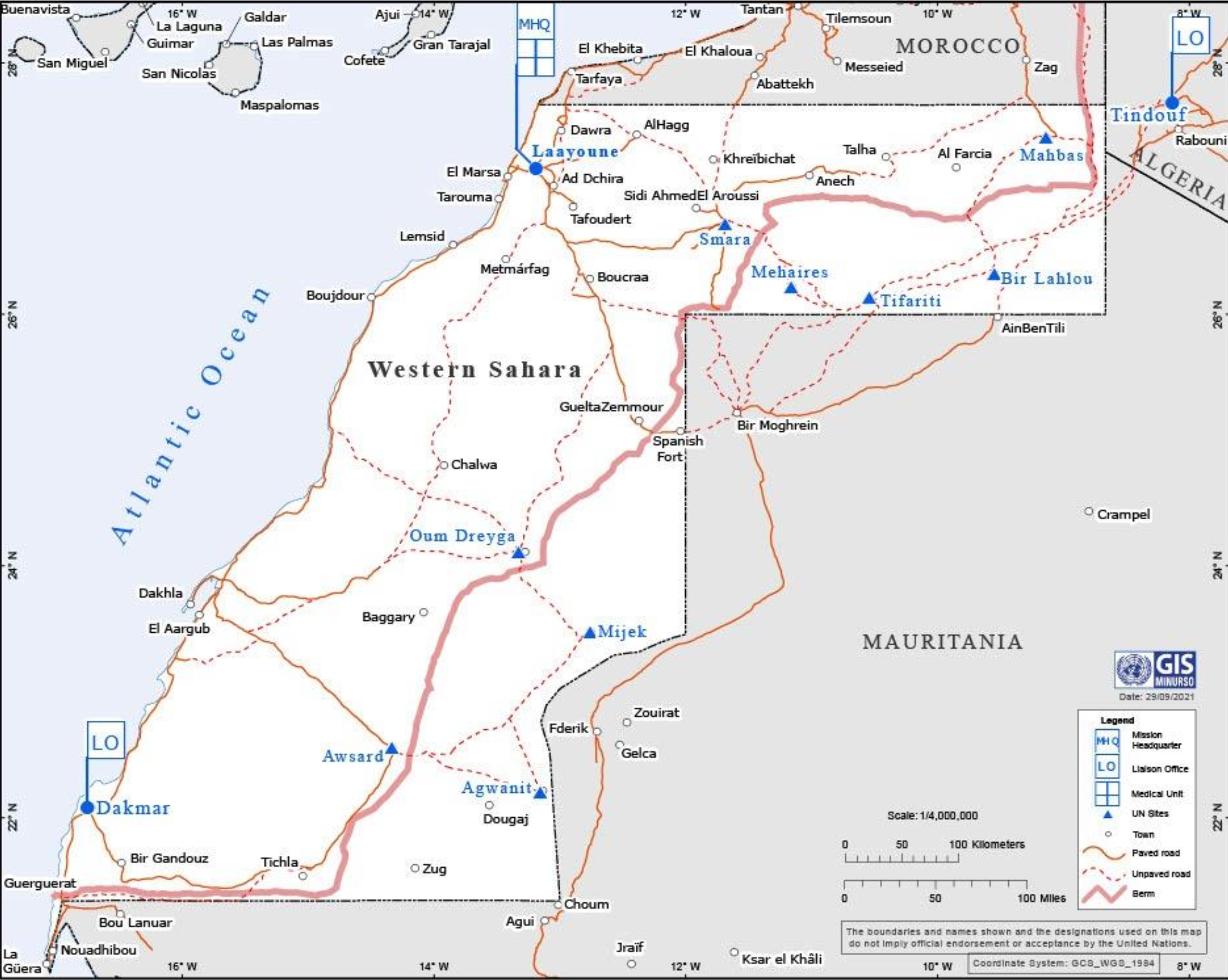
In 1979, Mauritania renounced all claims to Western Sahara, giving way to Morocco’s total takeover of their previously held territory. Beginning in 1980, Morocco also began the construction of the ‘Berm’, a sand wall dividing Western Sahara into two zones, one controlled by Morocco and the other by the POLISARIO Front (see figure 1). By 1982, the SADR was admitted into the Organisation of African Unity (OAU), prompting Morocco’s 1984 withdrawal in protest. In August 1988, Morocco and the SADR agreed to the United Nations (UN) ‘settlement proposals’. These proposals called for a formal ceasefire and a popular referendum that would enable the people of Western Sahara to choose between independence and integration into Morocco; however, the referendum was never implemented. The UN Security Council’s Resolution 690 in April 1991 established the UN Mission for the Referendum in Western Sahara (MINURSO). This initiative was tasked with overseeing the transitional period dedicated to the implementation of the settlement proposals, specifically the organization and execution of the long-anticipated referendum (United Nations Security Council, 2022). In September, the UN-brokered ceasefire entered force, establishing the Identification Commission (IDC) responsible for determining eligible referendum voters. Despite thorough attempts, the challenging process was suspended in 1996, and MINURSO military forces were reduced.
In 1997, the successful talks between Morocco and the SADR, mediated by the UN Secretary- General’s personal envoy James Baker, initially provided renewed hope. Yet, neither Baker’s diplomatic efforts including the comprehensive ‘Baker Plans’ nor the multiple ensuing efforts by Morocco, the POLISARIO Front, the UN, and other States throughout the 2000s and 2010s achieved the stipulated referendum or a final settlement. This persistent diplomatic failure is primarily attributable to the fundamentally irreconcilable positions held by the principal parties to the dispute. In October 2020, Sahrawi civilians conducted a protest at the Guerguerat Border Crossing in the south of Western Sahara, against territorial intrusions by Moroccan trucks seeking more direct access to Mauritania, violating the 1991 ceasefire’s border demarcations. Tensions escalated in November 2020 after Morocco issued an ultimatum, threatening the forcible removal of protestors if they did not withdraw voluntarily. The POLISARIO Front countered with its own ultimatum, pledging military action should Moroccan forces cross the UN ceasefire line. On November 13th, 2020, Moroccan forces entered the UN buffer zone to remove protestors, prompting a military response from the POLISARIO Front, deeming the 1991 ceasefire void. On December 10th, 2020, US President Trump formally recognised Moroccan sovereignty over Western Sahara in exchange for Morocco’s entry into the Abraham Accords, thereby normalising diplomatic relations with Israel. With the discovery of Israeli spyware on Algerian officials’ phones, Algiers severed diplomatic ties with Morocco among accusations of Moroccan espionage in 2021 (Luiss School of Government, 2024). In the same year, Morocco proposed autonomy for Western Sahara under the Moroccan King’s sovereignty, receiving gradual support from European powers, though Sahrawi political parties rejected the proposal. In 2023, Israel recognised Moroccan sovereignty over Western Sahara, joining the United States of America (USA) as the only States to do so. As of November 2025, hostility continues between Morocco and the Algeria-supported POLISARIO Front (Middle East Eye, 2025).
Part 2: Political Interventionism
The political interventionism engaged by both Algiers and Rabat has forged a self-sustaining stalemate, pitting the two parties’ mutually exclusive wills against one another, thereby impeding the realisation of an amicable resolution. Morocco’s interventionist strategy is deeply rooted in its historical, sui generis claim to territorial sovereignty over Western Sahara, a position that intentionally ignores decisions of international law, particularly the 1974 ICJ advisory opinion which rejected Moroccan and Mauritanian sovereignty claims. Morocco’s political interventionist strategy serves as a method for consolidation and expanded sovereignty recognition. This strategy encompasses a significant diplomatic outreach, beginning with its re-admission into the African Union (AU) in 2017 to cultivate African rapport while emphasising their ‘desire for conflict resolution’. Globally, Morocco strengthened its interventionist position through the tripartite agreement securing U.S. recognition of sovereignty in 2020 and its continual suggestion of compromise proposals in peace treaties. These proposals have garnered significant European support, particularly from France, the United Kingdom (UK), and Spain, effectively enhancing Moroccan regional legitimacy as a proactive pro-resolution actor. Therefore, Morocco’s political interventionism can be viewed as their method for expanding recognition, and consolidation, of sovereignty, utilising political strategy to gain legitimacy.
Contrastingly, Algeria’s strategy is grounded in an ideological commitment to Sahrawi self-determination, notwithstanding its strict policy of non-interventionism. This position stems from a national identity forged by its own colonial history, viewing Algeria as a “champion of African liberation movements and support[er of] self-determination for oppressed peoples around the world” (Aymane El Laiti Ben Ayaqd, 2023). Furthermore, this ideological compatibility between the POLISARIO Front’s Marxist-grounded orientation and Algerian revolutionary ideals – which catalysed independence – facilitates sustained support. This political interventionism is primarily manifested in its support for the development of the POLISARIO Front’s political infrastructure, enabling their continuing resistance against Morocco. Algeria strategically draws its justification for adopting the POLISARIO Front as a regional proxy from international law framings, utilising UN resolutions emphasising self- determination and the 1974 ICJ advisory opinion. The presence of an estimated 173,000 refugees living in refugee camps in Tindouf also provides Algiers with significant political leverage, positioning them as a moral defender of anti-colonialism, enabling their exertion of soft power over the displaced population, and solidifying a legitimate stake in the conflict. Overall, Algeria’s political intervention functions as an effective containment strategy against regional rival Morocco, a challenge to neo-colonial ideology, and a means of upholding the existing regional order to prevent destabilising power-shifts.
The divergent positions of Morocco and Algeria bring forth a compatibility dilemma, as each state’s political interventionism expresses an ideology fundamentally opposed to the other. This zero-sum dynamic ensures that any diplomatic success achieved by one party is perceived as a loss by the other - thus inhibiting advancement toward resolution as the imperative to maintain regional power stability outweighs the ‘risk’ of compromise in pursuit of peace. The influence of non-regional actors such as the USA, France, and the AU, has led to the prioritisation of stability over definitive resolution. This is particularly evident in the USA’s recognition of Moroccan sovereignty, France’s diplomatic defence of Rabat to preserve national interests, and the AU’s normative consistent, yet ineffective, support for the Sahrawi cause. Thus, the political interventionism of all involved State and non-State actors, has created a performative zero-sum legitimacy contest, where compromise is strategic defeat. Therein, the perpetuation of the conflict, serving as a mechanism to protect influence, has become the preferred operational outcome for both Morocco and Algeria.
Part 3: Economic Interventionism
A significant fiscal motivation underscores the regional interventionism in the Western Saharan question, intensifying pre-existing ideological divisions and inhibiting progress toward a final resolution. The territory possesses vast economic potential due to its abundant natural resources. Its 1100kms of coastline represents one of the world’s richest fishing regions (Aymane El Laiti Ben Ayaqd, 2023). Additionally, Western Sahara boasts 75% of the world’s phosphate rock reserves and has insofar (due to the conflict) unexplored oil and gas reserves along its extensive coastline. The large surface area, predominantly desert, with over 3600 hours of sunlight annually, also holds great potential for renewable energy. This considerable natural wealth provides a powerful motivation for Rabat’s strategy of territorial incorporation, while fuelling Algiers’ resistance against its neighbour and regional rival gaining access to such resources.
Morocco’s strategy has centred on the economic integration of Western Saharan into their national economy as a means of legitimising both its occupation and sovereignty claim. This is achieved through substantial investment in large-scale development projects, notably the expansion of the deep-water Dakhla Atlantic port and the expansion of 5G infrastructure, which provides access to the territory’s extensive natural wealth. Further consolidation of occupational control is planned through the development of 750 hectares of new economic zones by 2028, including the El Guerguerat road centre and the Dakhla logistics hub. These projects are designed to boost the territory’s economic integration and position it as a regional logistics centre under Moroccan administration (Henec Dossa, 2025). The participation of European companies in Morocco’s exploration of offshore oil fields, and the European Union's (EU) States’ economic relations – which capitalise on Western Sahara’s vast economic potential – provide indirect legitimacy to the Moroccan presence. This process is often framed as ‘greenwashing’, wherein states and corporations prioritise a territory’s renewable energy potential over political reality (Alex MacDonald, 2025). Ultimately, the economic dimension of Morocco’s intervention in Western Sahara serves as a significant soft-power tool, and a primary mechanism for the concrete integration of the territory into its national economy.
In contrast to Rabat’s integration strategy, Algiers’ economic interventionism in Western Sahara is decidedly more direct, marked by attempts to economically isolate and challenge Morocco. In 1994, Algeria closed its border to Morocco, restricting continental transport and economically isolating it from its Maghrebi and broader African neighbours. This physical economic barrier sought to limit Morocco’s capitalisation on Western Saharan natural resources and polarise the Moroccan market from sub-Saharan and Sahel trade networks. In tandem with this on-the-ground economic resistance, Algiers has promoted diplomatic and legal challenges to Morocco’s economic actions within Western Sahara. This is evidenced by their support for the POLISARIO Front’s challenge to EU-Moroccan trade agreements, which included Western Saharan resources without Sahrawi consultation, in the European Court of Justice (ECJ) in October 2024. Despite prompting a revision of the trade agreements, Algiers’ intervention was ultimately ineffective; the reform failed to fully satisfy the ECJ’s ruling mandating Sahrawi consent in Western Saharan resource extraction, demonstrating the growing prioritisation of EU states’ strategic and economic interests with Rabat over international law (Federico Petrangeli, 2025). Finally, attempting to continually impede Moroccan consolidation of sovereignty in Western Sahara, the Algerian government allocates an estimated €850 million annually to the POLISARIO Front (Frédéric Powelton, 2025). This significant financial commitment sustains the Front’s resistance efforts and constitutes a direct, systematic challenge to the geopolitical ambitions of its regional rival.
Overall, the Western Saharan question effectively encapsulates the zero-sum mentality driving the regional powers Morocco and Algeria away from each other, seeing any weakness or failure by the other as a victory. Paralysis in regional organisations such as the Arab Maghreb Union (AMU) is primarily caused by the Rabat-Algiers rivalry, which most potently manifests itself in the Western Saharan conflict. AMU member states have the potential to forge a regional economic power grounded in a wealth of natural resources, but the organisation’s stagnation has caused bilateral trade between members to reach less than 15% of its potential total (Abdennour Toumi, 2021). President Trump’s 2020 recognition of Moroccan sovereignty has been considered the ‘final nail’ in the coffin of the AMU. This decisive diplomatic action immediately spurred the Algerian-sponsored POLISARIO Front to re-initiate armed combat and violence, driving Rabat and Algiers even further apart and firmly obstructing regional cooperation. The most immediate cost of this renewed stalemate is the lost economic benefit possible through Maghrebi economic collaboration, estimated at $3 billion for the whole region in 2007 (International Crisis Group, 2007). Thus, in prioritizing relative zero-sum gain over cooperative absolute gain, both Morocco and Algeria demonstrate that the perpetuation of regional economic stagnation remains preferable to the risk of the rival achieving economic dominance through sovereign control of Western Sahara’s vast resource potential.
Part 4: Security Interventionism and the Broader Proxy Threat
The security situation in Western Sahara powerfully illustrates the drastic consequences of strategic conflict perpetuation. Morocco’s security interventionism is based on the assertion of physical control over the territory. The construction of the approximately 2,700km Berm strikes a stark physical separation, confining the Sahrawi people to only 25% of the territory. This military infrastructure reinforces the demographic engineering underway, notably the forced displacement of at least 200,000 Western Saharans by Moroccan forces since 1956 (Kang-Chun Cheng, 2024). Additionally, Rabat’s territorial settlement program sees approximately 400,000 Moroccans benefiting from state subsidies for their relocation (War on Want, 2025). Likewise, Algeria’s interventionism must not be viewed purely through the lens of gracious defence of self-determination. While ideologically rationalised as such, it is strategically designed to challenge its rival without direct military risk. By providing proxy military support to the POLISARIO Front, Algiers gains plausible deniability and a reduced direct stake in the conflict yet thereby supports a violent war which threatens Moroccan and Sahrawi lives. Expectedly, such territorial tension attracts broader international attention and intensifies the conflict’s proxy character. Though not officially confirmed, various international media reports indicate that Iran has supplied the POLISARIO Front with advanced weaponry and supervises the Front’s Algerian training camps in collaboration with Lebanon’s Hezbollah (The Arab Weekly, 2024). This support is mirrored by the strategic alignment of the USA and Israel with Morocco, alluding to a potentially emerging, frightening proxy dynamic which could propel the Western Saharan Question more prominently onto the global stage. Additionally, the Trump administration’s support for Morocco is viewed as a reactionary manoeuvre against China’s attempts to consolidate influence in Africa with the Belt and Road Initiative (BRI), and Russia’s intensifying involvement with quasi-military private companies, such as the Wagner Group, in West Africa. This bleed-over of East-West rivalry further reinforces the zero-sum stalemate argument on a global scale, where any progress toward resolution is perceived by one power bloc as too great a risk for its opponent to consolidate power. The security interventionism in Western Sahara thus reflects a spiral model of conflict, where each actor’s military measures justify the other’s threat perceptions, creating a self-perpetuating cycle where militarisation and tension are both the cause and consequence of the conflict’s intractability.
Part 5: The Conflict’s Perpetuation
A combined analysis of the elements of international interventionism effectively explains the enduring, tense stalemate in the Western Saharan conflict. The two principal intervenors, Morocco and Algeria, are both demonstrably served by the stalemate, as a definitive resolution threatens both states’ strategic interests. Morocco benefits by controlling the majority of Western Sahara while avoiding international isolation for occupying another African territory. Simultaneously, Algeria contains Moroccan expansion and maintains its ideological integrity through proxy support for the POLISARIO Front. Structurally, the fundamentally incompatible objectives of the conflicting parties inherently obstruct resolution. Morocco demands the fulfilment of its historical claim to sovereignty, while the POLISARIO Front and Sahrawi nationalists desire their own full sovereignty and reject any form of autonomy proposal short of complete independence. The persistent nature of the Western Saharan conflict is further entrenched by its linkage to domestic political legitimacy, particularly for the Moroccan King, who must uphold the monarchy’s foundational nationalism through an unwavering pursuit of the territory. Division in the international community, especially as previously exemplified in the European Union's unresponsiveness to ECJ rulings on their Moroccan trade deal, has further enabled this intractability. Lastly, the MINURSO’s limited mandate and enforcement power have impeded the UN’s ability to settle the conflict, leading to the resignation of several personal envoys.
Part 6: A Brief Application of Conflict Theory
Drawing upon theoretical frameworks, the irreconcilability of the Western Saharan conflict can be explained by the Theory of Social Conflicts, which attributes the stalemate to the ingrained hostility between the conflicting parties based on mutually exclusive sovereignty claims (Elisabeth H. Austrheim, 2023). Moreover, the Theory of Enduring Rivals posits that the normalisation of a state of conflict constitutes a lack of political shock, thereby impeding the ending of war (Elisabeth H. Austrheim, 2023). Combining these two theoretical approaches with the advantageous dynamics of proxy support and the zero-sum nature of the Western Saharan question, the conflict’s sustained prolongation can be comprehensively accounted for. Wholly, the self-fulfilling character of this half-century-long dispute has deepened commitment to the entrenched positions, impeding any significant progressive action from involved parties, only further perpetuating the inertial stalemate.
Conclusion
Conclusively, the various forms of interventionism in the Western Saharan conflict are interconnected mechanisms facilitating a deliberately perpetuated stalemate strategy. Both Rabat and Algiers have successfully reframed the Western Saharan issue from a post-colonial question into a managed conflict designed to serve their regional rivalry, without the risk of direct confrontation or compromise. Despite intensive international attempts to resolve the conflict, Western Sahara has remained the playground for world powers to test alliances and challenge rivals. The contemporary character of the international community, marked by often ineffective statements of condemnation, calls for peace, and rhetorical encouragement, has fundamentally failed the people of Western Sahara. Thinly veiled prioritisation of state interests has caused the abandonment of the true victims in what remains of Africa’s final, unanswered postcolonial question.
Figures
Figure 1: United Nations MINURSO Map of Western Sahara:
United Nations. (2020, April). Map of Western Sahara. Department of Geospatial Information Services. Retrieved from https://www.un.org/geospatial/sites/www.un.org.geospatial/files/files/documents/2020/Apr/western_sahara_3175_r5_jan20.pdf
Bibliography
Accord. (2020, February 9). Conflict resolution in Western Sahara. Retrieved from https://www.accord.org.za/conflict-trends/the-western-sahara-conflict-on-an-evolving-african-security-landscape/
Austrheim, E. H. (2023). The last colony: Theoretical explanations on the protractedness of the Western Sahara conflict. Journal of African Conflicts and Peace Studies, 5(2), 1–51. https://digitalcommons.usf.edu/jacaps/vol5/iss2/1
Ayaqd, A. E. L. B. (2023). The Moroccan Sahara Conflict: The Four Decade Long Unresolved Conflict. Retrieved from https://www.final.edu.tr/docs/tezler/Aymane%20el%20laiti%20ben%20ayaqd%20thesis%202023.pdf
Blila, W. (2025). Maghreb power struggle: An offensive realist analysis of Moroccan-Algerian rivalry. International Journal of Social Science and Social Research, 2793, 1–10.
Centre for Strategic and Security Initiatives. (2024). Western Sahara: A frozen conflict. Retrieved from https://cis-fpn.rs/wp-content/uploads/2024/02/Western-Sahara-A-frozen-conflict.pdf
Crisis Group. (2024, December). Managing Algeria-Morocco. Retrieved from https://www.crisisgroup.org/sites/default/files/2024-12/247-managing-algeria-morocco.pdf
Ecofinagency. (2025, October 31). Morocco to invest $3.1 billion in high-speed rail, airports, and logistics zones. Retrieved from https://www.ecofinagency.com/news-infrastructures/0111-50049-morocco-to-invest-3-1-billion-in-high-speed-rail-airports-and-logistics-zones
European Parliament Directorate-General for External Policies. (2010, November). Western Sahara conflict. Retrieved from https://www.europarl.europa.eu/meetdocs/2009_2014/documents/dmag/dv/dmag20101130_04_/dmag20101130_04_en.pdf
European Union Institute for Security Studies. (2024). Shifting alliances in West Africa: Measuring Russian engagement and support for counter-terrorism efforts. Retrieved from https://www.iss.europa.eu/publications/briefs/shifting-alliances-west-africa-measuring-russian-engagement-support-counter
Heritage Foundation. (2024). Breaking the stalemate: A strategic framework to resolve Western Sahara. Retrieved from https://www.heritage.org/africa/commentary/breaking-the-stalemate-strategic-framework-resolve-western-sahara
Horizons Magazine. (2025, May 23). International conference on the Sahara: Towards a definitive settlement of the conflict. Retrieved from https://horizons.ma/international-conference-on-the-sahara-towards-a-definitive-settlement-of-the-conflict/
Human Rights and Rehabilitation Network. (2018). Western Sahara. Retrieved from https://www.hlrn.org/img/documents/Lakhal_Western_Sahara_EN.pdf
Institut Français des Relations Internationales. (2015). Questioning Algeria's non-interventionism. In Algeria: A new regional power? (pp. 1–12). Retrieved from https://www.ifri.org/sites/default/files/migrated_files/documents/atoms/files/pe_2015-3_porter.pdf
Istituto Affari Internazionali. (2024). EU-Morocco trade and the Western Sahara: Prolonged struggle between law and realpolitik. Retrieved from https://www.iai.it/en/pubblicazioni/c41/eu-morocco-trade-and-western-sahara-prolonged-struggle-between-law-and-realpolitik
Larosch, D. (2007). Western Sahara: International status and perspective (Clingendael Security Paper Series). Netherlands Institute of International Relations. Retrieved from https://www.clingendael.org/sites/default/files/2016-02/20070500_cdsp_paper_larosch.pdf
Lakhal, K. (2018). Western Sahara: Decolonization and human rights. Human Rights and Rehabilitation Network. Retrieved from https://www.hlrn.org/img/documents/Lakhal_Western_Sahara_EN.pdf
Luiss School of Government. (2024). Sleepwalkers into war: Algeria and Morocco on the path to conflict. Retrieved from https://mp.luiss.it/archives/sleepwalkers-into-warare-algeria-and-morocco-on-the-path-to-conflict/
Mediterranean Dialogue. (2024). EU-Morocco relations and the Western Sahara dispute.
MENARA Working Paper, 20, 1–15. Retrieved from https://www.iai.it/sites/default/files/menara_wp_20.pdf
Middle East Eye. (2025, November 5). Fifty years of plunder: How Morocco and its allies profit from Western Sahara. Retrieved from https://www.middleeasteye.net/news/western-sahara-fifty-years-plunder-profit-morocco-allies
Modern Diplomacy. (2025, May 15). Self-determination is the only endgame for WesternSahara. Retrieved from https://moderndiplomacy.eu/2025/05/15/self-determination-is-the-only-endgame-for-western-sahara/
North Africa Risk Consulting. (2015). Why and how the Algerian regime sponsors the Polisario in Tindouf. Sahel Intelligence Analysis. Retrieved from https://sahel-intelligence.com/39975-algeria-why-and-how-the-algerian-regime-sponsors-the-polisario-in-tindouf-cns-analysis.html
Ordemann, P., & Barlı, N. (2024). Is Morocco's normalization the last nail in the coffin for the Arab Maghreb Union? ORSAM Brief Series. Retrieved from https://orsam.org.tr/en/yayinlar/is-morocco-normalization-the-last-nail-in-the-coffin-for-the-arab-maghreb-union/
Pulitzer Center. (2024). Essay: The continued occupation of Western Sahara. Retrieved from https://pulitzercenter.org/stories/essay-continued-occupation-western-sahara
Sahara Resource Center. (2010). Self-determination and Western Sahara: A history of international legal disputes. Retrieved from https://www.arso.org/Self-DeterminationJSmith310310.pdf
Security Council Report. (2020, November 2). Western Sahara: Chronology of events. Retrieved from https://www.securitycouncilreport.org/chronology/western-sahara.php
Security Council Report. (2025, September 29). Western Sahara: October 2025 monthly forecast. Retrieved from https://www.securitycouncilreport.org/monthly-forecasts/october-2025-monthly-forecast
Smith, J. (2010). Self-determination and Western Sahara: A history of UN mediation. Arab Studies Journal, 15(2), 45–67.
Strategic University. (2023). Western Sahara and the future of North African security [Thesis collection]. Deusto University. Retrieved from https://www.imaf.cnrs.fr/IMG/pdf/call_conference_western_sahara_-_deusto_-_may_9-10_2024_eng.pdf
Taylor & Francis Online. (2024, December 17). Western Sahara: Regional geopolitics and international dimensions. African Security Review, 33(3), 1–24. https://www.tandfonline.com/doi/full/10.1080/03050629.2024.2421502
United Nations. (1996, May 29). Statement by the Security Council (Press Release SC/6226). Retrieved from https://press.un.org/en/1996/19960529.sc6226.html
United Nations. (2020, April). Map of Western Sahara. Department of Geospatial Information Services. Retrieved from https://www.un.org/geospatial/sites/www.un.org.geospatial/files/files/documents/2020/Apr/western_sahara_3175_r5_jan20.pdf
United Nations Security Council. (2024, December 31). S/2025/620: Report on the situation concerning Western Sahara. Retrieved from https://docs.un.org/
University of Adam Mickiewicz. (2024). Western Sahara conflict: Historical perspective and contemporary challenges. Academic Repository. Retrieved from https://repozytorium.amu.edu.pl/bitstreams/c96ab502-a6ef-4947-bf70-187bdb3c60b9/download
U.S. Department of State. (2008). Western Sahara: Background notes. History and Country Records, 2001–2009. Retrieved from https://2001-2009.state.gov
World Politics Review. (2025, August 11). Morocco makes a new case for sovereignty over Western Sahara. Retrieved from https://worldpoliticsreview.com/