From Damascus to Italy: The Criminalization of Syrian Migration and Humanitarian Aid
January 2026 by Giordano Di Glori
Introduction
The Assad family’s hold on Syria was forged not by popular consent, but by military coup. Hafez al-Assad’s “Correctionist Movement” seized power in 1971, initiating what would become, by 2024, one of the world’s longest-enduring authoritarian dynasties; a marriage of sorts between ruler and ruled destined to fracture. This system strategically placed the Alawite religious minority at the head of the state’s vast security and political apparatus. Yet, by March 2011, this precarious equilibrium irreparably ruptured. The catalyst came with the regime's excessive brutality, when the Mukhabarat – the regime's security forces – returned the tortured body of Hamza al-Khatib, a thirteen-year-old student who had dared to draw defacing graffiti over images of Bashar al-Assad in Daraa. This singular act of official violence ignited popular uprisings across Syria, transforming simmering social unrest into a protracted Civil War. .
Between 2011 and 2020, the Syrian Civil War resulted in the displacement of 13.4 million people. The international response, however, was markedly fragmented: neighboring countries bore the burden, with Turkey hosting 3.7 million refugees and Lebanon seeing its precarious stability threatened by the influx of nearly a million. While the United States, under President Obama, invoked a symbolic “red line” , Europe's response was defined by prolonged debate and indecision. This de facto decision to not decide, has forced Europe into a complicated relationship with the Syrian government. This article aims to expose the corrosive “marriage” between Syria’s systemic abuse of power and Europe’s migration deterrence policies - an alliance solemnized in Libya, enforced across the Central Mediterranean, and whose crises reached the border towns of Ventimiglia and Menton.
The Syrian diaspora was characterized by its heterogeneous nature, driven by the confluence of widespread protests and the social superiority granted to the Muslim Alawite branch within Syria’s security and state apparatus. This led to heterogeneous emigration of the Syrian community, spanning from high-profile exiled political leaders such as George Sabra to ordinary families seeking refuge. Despite their diverse origins, these diaspora fragments were united by a shared commitment to Syria’s future governance and reconstruction. Indeed, according to the Office for the Coordination of Humanitarian Affairs (OCHA), between 2011 and 2015 more than 600 ‘local’ groups were created in response to the crisis. Yet, this internal Syrian engagement also underscored the difficulties faced by humanitarian foundations in responding to the crisis. Ultimately, the international community’s failure to constrain Bashar al-Assad’s use of violence, combined with a weak humanitarian response, led to the externalization of the Syrian population, turning a domestic crisis into a global displacement challenge.
Section 1: A deteriorating marriage; The Civil War
Although separated by approximately 4000 km, Damascus and the neighborhood of Sidi Bouzid in Tunis were spiritually linked by the revolutionary current of the Arab Spring. The regional wave of dissent began on December 17th 2010, when street vendor Mohammed Bouazizi self-immolated in Sidi Bouzid, protesting against the poor economic conditions that the country was facing. This act sparked pro-democratic movements that rapidly culminated in the ouster of Tunisian president Ben Ali in January 2011. The same defiant spirit soon migrated eastward. On February 17th 2011, after a security guard insulted a merchant's son in Damascus’s Al-Harika Market, over 1500 Syrians rallied with the chant, “The Syrian people will not be humiliated!” – a direct echo to the same dignity denied to Mohammed Bouazizi. The true ignition of the revolution occurred in Daraa in early March 2011, following the arrest of children, some under the age of thirteen, for protesting against the Syrian authorities. Local grievances had united in a collective national movement aimed at reclaiming freedom of expression and opinion, which had been systematically suppressed by the regime’s social media censorship and violent security apparatus.
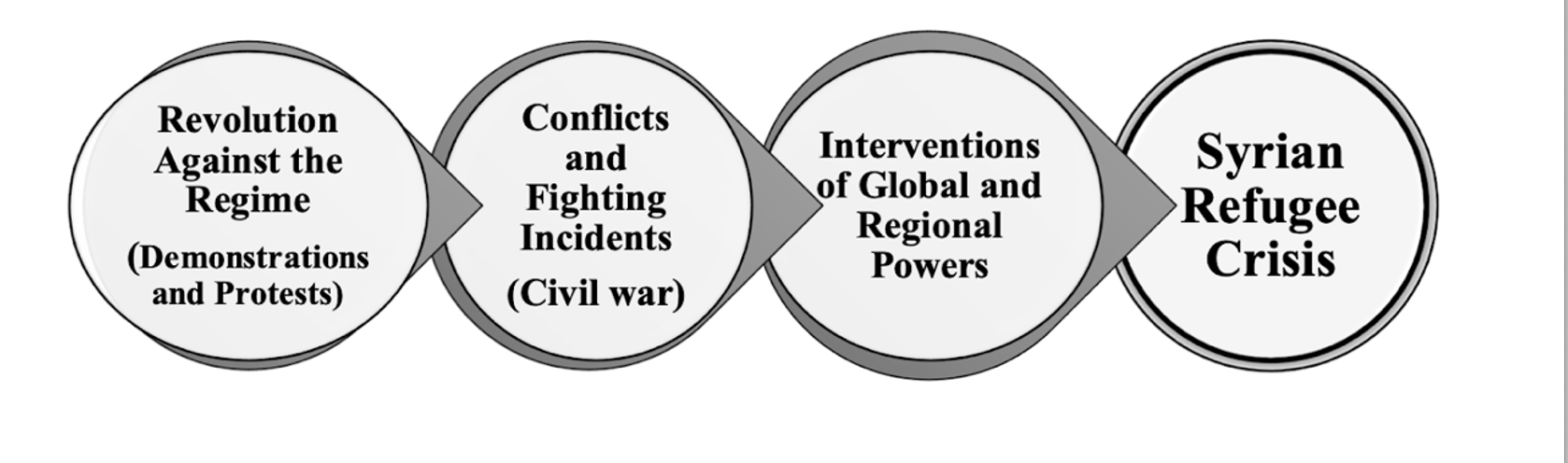
Image 1: The Development of the Syrian Civil war (Aldamen, 2025)
The democratic protests were met with unprecedented brutality by the Assad regime. Those who had participated in early political activism became primary targets and were forced into exile. The human cost quickly became astronomical : the Syrian Observatory for Human Rights estimated that over 500,000 Syrians had been killed by 2017, and that up until 2015, 4.9 million people had been driven into exile as registered refugees. While global powers attempted to challenge Assad’s use of chemical weapons, such as in the Ghouta chemical attack of 2013, state actors like Russia and Iran decisively intervened to stabilize the Assad regime precisely when the opposition seemed to have gained momentum. Russian airstrikes, often justified as counter-terrorrism measures against ISIS, frequently focused on anti-Assad rebel groups such as the Syrian Free Army (SFA), allowing the government's maintenance of control. By 2015, as the conflict became increasingly militarised and the national economy shattered, almost half of the Syrian population was either internally displaced or had been forced to seek refuge in neighboring countries.
Section 2: Displacement patterns
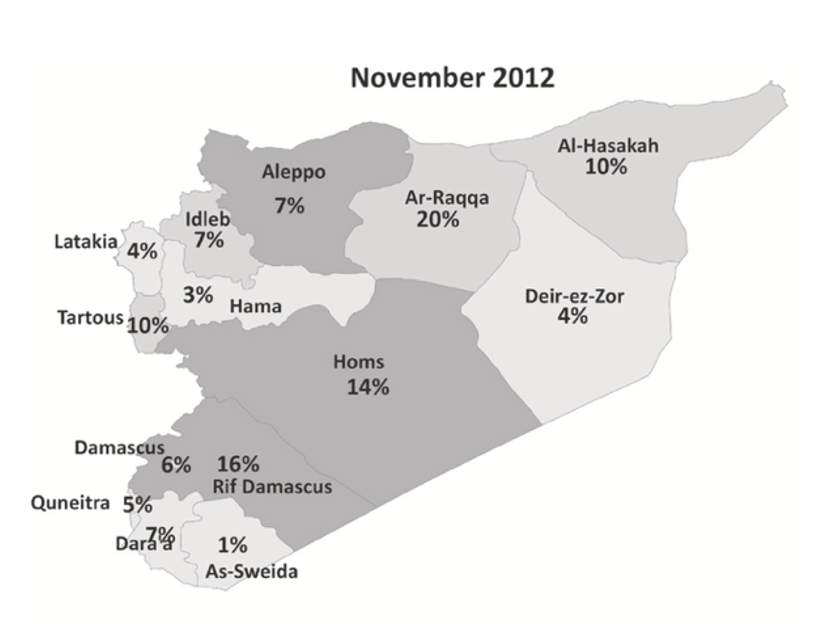
The earliest population displacements emerged from southern and central Syria during the first phase of the conflict. The town of Talkalakh in Homs Governorate witnessed the first significant refugee exodus in May 2011, immediately following the Assad regime’s brutal suppression of anti-government demonstrations. The strategic importance of Homs and its control – initially held by opposition forces before eventual an eventual regime recapture – necessitated prolonged cycles of intense combat, making the central governorate a critical early source of internal and external
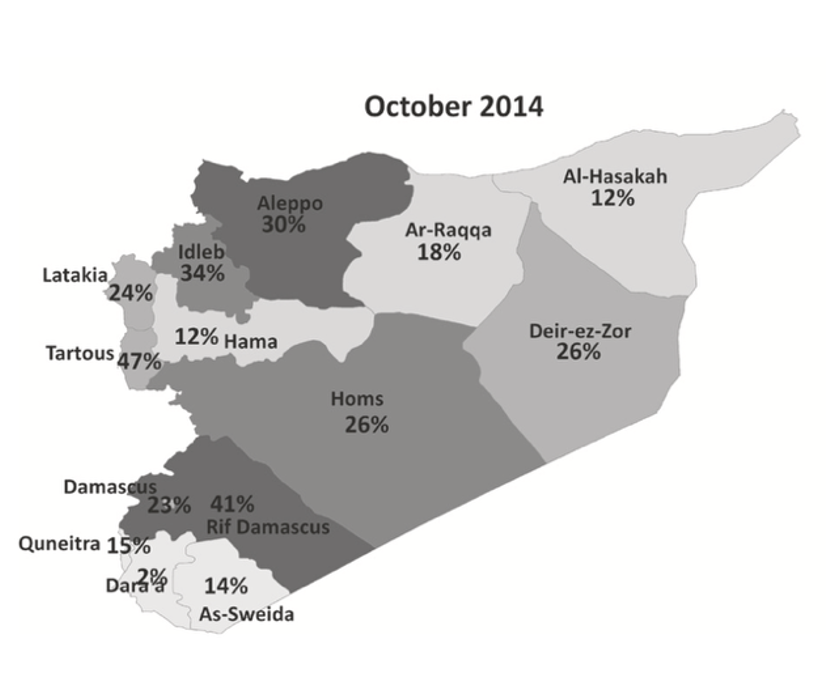
As the conflict expanded, the displacement dynamics began to shift. Aleppo, Syria’s largest city, became the central theater for military confrontations during the extended Battle of Aleppo (2012 - 2016). Opposition forces, such as Hay'at Tahrir al-Sham (HTS) and the Levant Front contented the city with pro-Assad parties. The resulting urban warfare led to a massive demographic crisis, culminating in 1.787 million displacements by October 2014. The governorate’s unique dual position, as Syria’s primary commercial hub and its proximity to the Turkish border, made it both a highly valuable strategic prize and the most logical destination for those seeking safety
Turkey rapidly emerged as the primary destination for refugees riginating from Aleppo and northwestern Syria, typically attracting those with the necessary economic means and geographical proximity.. Syrian nationals initially benefitted from critical advantages in border access: under a 2009 bilateral mobility agreement, they were granted visa-free entry into Turkey until 2015, and the government initially maintained an open border policy despite security concerns. This policy framework created a demographic skew, primarily favoring younger, working-age populations with the resources and connections required for efficient mobility.
Parallel to this, the Jaber border crossing in northeastern Jordan received the highest concentration of refugee arrivals from the southern Syrian territories. However, Jordan’s border policies introduced systematic restrictions designed to filter and differentiate refugees by social category. As early as 2012, Jordan had implemented entry bars against specific groups, including Palestinian refugees who had been living in Syria, unaccompanied men without family ties in Jordan, and people without valid identity documentation. Unlike Turkey’s demographic concentration on younger workers, the strict filtering process in Jordan resulted in a refugee population characterised by higher proportions of family units., This is evidenced by reports indicating that up to 60% of Syrian children were born outside the Syrian territory.
Parallel to this, the Jaber border crossing in northeastern Jordan received the highest concentration of refugee arrivals from the southern Syrian territories. However, Jordan’s border policies introduced systematic restrictions designed to filter and differentiate refugees by social category. As early as 2012, Jordan had implemented entry bars against specific groups, including Palestinian refugees who had been living in Syria, unaccompanied men without family ties in Jordan, and people without valid identity documentation. Unlike Turkey’s demographic concentration on younger workers, the strict filtering process in Jordan resulted in a refugee population characterised by higher proportions of family units. Yet, amongst Syrians in search of work, discontent was manifested as they were constrained to low-wage sectors such as agriculture and construction, often in informal employment, as shown by a report by the Migration Policy Institute (Salameh, 2025).
Lebanon’s policy was initially distinguished by its commitment to an entirely open border for Syrian refugees, without visa requirements, leading to the influx of the most vulnerable and resource-constrained populations. Lebanon however opted not to develop a formal policy of placing Syrians into refugee camps, a decision rooted in the enduring sociopolitical issues associated with previous establishments of Palestinian refugee camps. Consequently, refugees who did not meet the restrictive criteria to enter Jordan or reach Turkey – primarily those from Syria’s western and southwestern regions Homs, Hama, Lattakia, and Rif Damascus – were often channeled intoLebanon. Over time, however, tense social and economic dynamics led Lebanon to adopt increasingly restrictive measures, including the tightening of residency rules through the requirement of local sponsorships and fees. While data was hardly collected, as early as 2012, Human Rights Watch had reported Lebanon was struggling to meet the international principle of nonrefoulement.
Section 3: Syrian displacement in Libya
On March 18th, 2016, the landmark EU-Turkey deal was implemented with the explicit aim of dismantling what had been the main route Syrians used to reach Europe. The agreement institutionalized the systematic and “rapid return of all migrants not in need of international protection crossing from Turkey to Greece and to take back all irregular migrants intercepted in Turkish waters” in exchange for EU disbursement and the acceleration of Visa processing for Syrian refugees. This policy intervention effectively pushed smuggling networks and desperate asylum seekers to find an alternative passage. The Central Mediterranean route via Libya was already a viable, though more perilous, option. In 2013 and 2014, Syrian immigration to Italy via this route accounted for 26% and 25% of total arrivals (GLOBAL MIGRATION & DATA ANALYSIS CENTRE, 2016), respectively, indicating a 30,000 increase in crossing over the years. However, this proportion sharply decreased to 5% in 2015, when approximately 500,000 Syrians instead favored the Eastern European route to Greece, only to return to the Libyan path after the 2016 deal took effect.
The post-2015 increase in the Libyan route was intrinsically linked to a broader movement towards the West, as Syrians travelled across North Africa in search of a runaway to Europe. A 2015 report by the International Organization for Migration (IOM) noted that the flow of asylum seekers had effectively doubled in Egypt over the preceding two years, leading to a documented deterioration of protection for Syrian refugees (Malakooti, 2015). The overall increase of Syrian immigration in Northern Africa was due to the region’s initial lenient visa requirements. Libya has historically maintained no visa requirements for Syrians, while Egypt and Algeria only introduced restrictions in 2013. While some Syrians landing in Egypt attempted direct sea crossings, the majority continued their path towards Libya to cross the Mediterranean.This funneling effect meant that departures from Libya constituted an overwhelming 80% of all documented arrivals in Italy.
Libya’s descent into a major migration transit hub was a direct consequence of the geopolitical upheaval triggered by Muammar Gadhafi’s overthrow in 2011. Gadhafi, who had ruled the nation since 1969, was overthrown and killed during a NATO-backed uprising. . The revolution was preceded by protests in Zawiya starting as early as 2009, and was decisively ignited when demonstrations reached Benghazi in February 2011. As the conflict spread nationally , forces opposing Gaddafi united under the interim National Transitional Council. However, the council faced several obstacles, as the subsequent power vacuum was exploited by the Islamic State and other armed groups as a means to spread terror and conflict.This instability fueled attacks not only against foreign entities, such as the American embassies, but also directed violence towards migrants within Libya. Economic conditions rapidly worsened, with oil production entirely stopping by 2013 as militias gained control over a large part ofLibyan territory. The civil war reached its peak in May 2014 when General Khalifa Haftar launched Operation Dignity, a major campaign conducted by the Libyan National Army (LNA) to target the Libya Dawn coalition of Islamist militants and military groups.
Libya’s collapse under the weight of civil war created a toxic symmetry between its internal chaos and Europe’s migration deterrence policies. As the conflict intensified, conditions for Syrian refugees in Libya rapidly deteriorated, forcing many toward the precarious maritime route to Europe. Like their counterparts in Lebanon and Jordan, Syrians faced particular social retention and increasing hostility. Initial rumors linking migrants to the Ghadafi regime during the 2011, were later supplanted by suggestions of migrants ties to particular militia groups in 2014. As general sympathy began to decrease, so did critical benefits previously accorded to Syrians, such as free access to healthcare and education. Furthermore, as the transitional government attempted to gain ground, Gadhafi’s legacy continued to shadow and influence migration policies : Libya's systematic failure to implement the 1969 OAU Convention on refugees or establish any asylum procedures meant that Syrian refugees, like all other migrants, were legally treated as irregular migrants. This status subjected them to arbitrary detention, criminalization, and abuse. The scale of this confinement was staggering : as of March 2015, the Libyan Directorate for Combatting Illegal Migration’s (DCIM) had declared the presence of 18 detention centers ( with 15 operating) with close to 5000 detainees across the country. Of even greater concern was the proliferation of additional detention centers controlled by militia groups, whose purpose was to further develop and profit from the smuggling market. Migrants were detained for indefinite periods of time, with only three principal, exploitative means of exit (Malakooti, 2015): being forced to purchase their freedom for a spot on a smuggler’s boat to Europe;being involuntarily pushed onto boats without having paid or expressed interest in reaching Europe; or being released only to be requested for manual labour as a form of cheap, coerced servitude.
By 2016, UNHCR had registered approximately 38,000 refugees and asylum seekers in Libya, nearly half of whom were Syrian nationals. Under each of these circumstances however, the freedom of Syrian refugees was severely restricted.
In recent years, a new layer of criminality was unveiled : a major human trafficking network fostering a smuggling business that, paradoxically, runs from Italy back toward Libya, estimated by a, a May 2021 United Nations Interregional Crime and Justice Research Institute report to be worth between 89 and 236 million USD. Syrians aiming to migrate to Europe have been actively exploited by being taken to Libya on commercial flights. These flights are operated by the private Syrian Airline company, Al Cham Wings, in cooperation with the Military Investment Authority of the Libyan National Army (LNA). The airline company is in charge of organizing direct trips to Benghazi from Beirut, Amman and Damascus, effectively bypassing the difficulties and dangers of land border crossings. The security clearance documents required to enter Libya are provided directly by the travel agency itself, which in turn pays the Libyan authority a fee of 500$ for every migrant ticket purchased.
Once in Libya, migrants are moved by smugglers towards the western regions or depart from eastern shores like Tubrok. The cost of the subsequent smuggling journey across the Mediterranean to Italy ranges between $2,500 and 4,000 per person departing from eastern Libya. The Al Cham Wings company had previously been sanctioned by the European Commission for allegedly smuggling migrants from Damascus to the Belarusian capital, Minsk. However, as those specific charges have reportedly been dropped, no sustained action has been taken to suppress either Libyan or Syrian role in the Central Mediterranean route.
Section 4: The European Interaction with Libya
Italy’s relationship with Libya has undergone fundamental change over the past two decades, initially marked by reconciliation largely steered by Prime Minister Silvio Berlusconi’s and Muammar Gadhafi. Following decades of estrangement that began with Gaddafi’s rise to power in 1969 and the subsequent expulsion of Italian settlers in 1970, the turning point was the Treaty of Benghazi, signed on August 30, 2008. It was the first formal apology made by a colonial power and included a significant financial compensation package ($5 billion over 20 years) for its colonial history. However, the underlying, tacit principle of the agreement was a transactional exchange : Italian reparations and development investment were exchanged for Libya’s commitment to prevent the surge of boats directed to Europe departing from its shores. In the previous years, growing anti-immigrant sentiment had already led to violent clashes between Libyans and migrant workers, who were now facing deportations, arbitrary detentions and violent abuses. The foreign view of Libya shifted from a final destination to a critical part of a greater migratory path to Europe. The relationship was further strengthened in 2010 when, following Gadhafi’s explicit threat that “thousands of people will invade Europe from Libya”, the EU signed a migration cooperation agenda that provided financing to Libya in exchange for tighter border control.
When the Gadhafi’s regime was finally toppled – an uprising initially opposed by Italy, despite its later participation in the NATO intervention – a new, destabilized relationship opened up. The same Berlusconi, who would lose power later that year due to the European Debt Crisis, suddenly lacked a stable counterpart capable of controlling border departures in Libya. However, the underlying Italian and European policy logic of externalizing border control survived the regime change. This partnership was formally renewed on February 2nd, 2017, through the Memorandum of Understanding (MoU) signed by Prime Minister Paolo Gentiloni, who had formed a new center-left coalition government after Matteo Renzi’s resignation. Aligned with Libyan Prime Minister Fayez al-Serraj, the Memorandum’s main objective remained the externalization of Italian borders, aiming to transform Libya into Europe’s primary offshore detention and interdiction zone. Regardless of the political orientation of the Italian government – whether left or right-ed –, the Italian state has consistently pursued policies aimed at suppressing irregular migration. In 2018, Luigi Di Maio, serving in a government with far-right Minister of Interior Matteo Salvini, stated : “We save the migrants with our navy, with our coastguard, but the NGOs [should] go elsewhere”(Kirchgaessner, 2018). Indeed , since 2017, and especially with the rise of populists movements across Europe, Italy and the EU have invested over €59 million in building Libyan Coast Guard (LCG)’s capacity. This funding facilitates the integration of Italian and Libyan rescue coordination systems, creating a structure engineered to redirect migrants toward interception and return to Libya rather than direct rescue and processing in Europe.
Section 5: European management of Refugees
The Central Mediterranean route remains the primary gateway pursued by refugees in Libya. Syrian migrants, alongside those from Africa, the Middle East, and South Asia,undertake perilous sea crossings from Libyan shores to reach Italian territory. Primary disembarkation points, including Sicily (Lampedusa), and Calabria, have become synonymous with Europe’s migration management crisis. Upon arrival, migrants enter the loop of the “CAS” (Centri di Accoglienza Straordinaria) and Hotspot system. This mechanism, established as part of the European Agenda on Migration, was intended to enhance security and efficiency by screening entrants and determining asylum eligibility .. However, the system has faced harsh criticism since its inauguration due to the sites’ legal ambiguity and documented fundamental rights violations. The Hotspot process, which involves medical screening, identification, and fingerprinting, has been found to illegally (according to Italian law) detain minors, and systematically utilises coercive measures, including physical force and prolonged administrative detention.
As the refugee crisis grew, so did the number of Hotspot centers, as they expanded rapidly across and doubled in number between 2014 and 2017.. This increase coincided with the implementation of the Italian Dispersal Policy (Piano Nazionale di Riparto) in 2014. A report titled “The Refugee Crisis and Right-Wing Populism: Evidence from the Italian Dispersal Policy” analyzed the political consequences of this policy. t, The study concluded that positive and significant effect of the share of asylum seekers settled in a given area on local support for radical-right anti-immigration parties, such as Lega and Fratelli d’Italia. Most importantly, the resentment toward refugee settlement was not caused by economic losses, such as a drop in local average income, but rather by radical-right propaganda. The positive impact of refugee share on anti-immigration support was significantly higher (by about 1 percentage point) in areas where right-wing electoral rallies occurred. This effect was even larger where candidates used hate speech, a phenomenon that can be explained by the dog-whistle theory found in political communication. Following the policy trajectory installed by the 2017 Memorandum of Understanding with Libya, the political language surrounding migration fundamentally shifted from humanitarian to security-focused frameworks. Parties like Fratelli D’Italia, for instance, characterized North African and Middle Eastern migrants as “threats” and “security risks” (Dettmer, 2018) rather than vulnerable populations fleeing conflict and persecution. This rhetorical shift highlights a conflicting double-standard when compared to the recent, notably more welcoming approach towards Ukrainian refugees.
The Italian government, led by Prime Minister Giorgia Meloni since 2022, has continued the track set forward in previous years, imposing complex administrative restrictions on NGOs and their Search and Rescue (SAR) operations in the Central Mediterranean. These policies involve imposing complex administrative requirements, such as the mandatory collection of asylum applications aboard rescue ships as well as the prohibition of SAR rescue ships to conduct more than one rescue mission per voyage before disembarkation. Critics argue that this policy directly contradicts the principle of non refoulement. Following the approval of a new “code of conduct” for NGOs by the Italian government, this operational restriction drew immediate criticism. Juan Matias Gil, head of sea rescue operations for Doctors Without Borders, stated that the decree “attempts to limit our scope of action without proposing any alternative solution,” with inevitable consequences for rescue capacity and lives lost at sea. A significant precedent for this policy framework was established during the tenure of Lega leader Matteo Salvinias Minister of the Interior (2018-2019). Salvini publicly stated his ministerial goal was to restrict the arrival of migrants in Italy, and in multiple cases, rejected the docking of rescue vessels at safe ports, such as Lampedusa. Specifically, on June 12th, 2019, the SAR vessel Sea Watch 3 rescued 53 migrants off the Libyan coast. After the ship rejected Tripoli due to safety concerns and headed toward Lampedusa – which represented the nearest safe harbor under maritime law –Minister Salvini refused authorisation to dock. On June 29th, citing the deteriorating condition of the passengers after over two weeks at sea, ship's captain Carola Rackete docked the vessel without authorization . Rackete was arrested by the Italian authorities after docking. Matteo Salvini publicly accused Rackete of attempting to sink an Italian patrol boat that was attempting to intercept her, an action he termed an “act of war”, which later led to a defamation lawsuit by the Sea-Watch’s captain.
Conclusion
The Syrian presence in France is a natural extension of the European arrivals of Syrian refugees within Greek and Italian territory. Similarly, the challenges faced by Syrians are no different in nature to the racial and xenophobic threats made possible by Europe’s externalization policy. This article has argued that the current crisis is the result of a "toxic symmetry" between the Syrian regime’s systematic violence and Europe’s unwavering commitment to migration deterrence.
The policy of externalization of borders that European leaders such as Silvio Berlusconi have opted for, fostered a criminalized and monetized transit system within Libya. While Europe preserved its reputation of an accepting and inclusive environment, its cooperation with the Libyan authorities suggested otherwise. The collapse of Gaddafi’s institutions allowed for the emergence of a highly profitable smuggling market where migrant exploitation is effectively state-sanctioned. Companies like the Al Cham Wings network, alongside the Military Investment Authority of the Libyan National Army (LNA), entrenched Syrian struggles with Libyan national policies that placed European institutions in a chokehold. Even with the takeover of left-wing parties in Italy, documents such as the 2017 Memorandum of Understanding formalized the displacement of Syrians into a lucrative business, bypassing land borders in favour of exploitative smuggling routes.
A path that was followed by the same Giorgia Meloni after her election, highlights a failure that goes beyond the political spectrum, symbolic of an institutional failure at its core. The recent legal hardening of the securitization agenda is evident in the Meloni government’s new "code of conduct" for NGOs. By imposing administrative restrictions -such as the single-rescue mandate- the Italian state has formalized the obstruction of Search and Rescue (SAR) operations. This effectively codifies the earlier, ad-hoc tactics used by Matteo Salvini, such as those seen during the Sea Watch 3 incident, turning political posturing into rigid administrative law that directly contradicts the principle of non-refoulement. Yet, instead of tackling the source of the displacement, the European response only fostered internal discrimination and refoulement within the borders.
A study by the Danish Refugee Council’s Diaspora Programme on the Syrian Diasporas reflected a rise of aggregatory Syrian movements within France after the Syrian Civil War (Nora Jasmin Ragab, 2017). The aggregatory spirit brought to light a state of vulnerability, highlighting difficulties including limited access to quality language training, hurdles in diploma recognition and limited access to higher education. Italian policies have evolved into a strategic "bottleneck" where its unsought integration of the refugees clashes with the systemic rejection faced by thousands that are denied the entrance into other European states.
Bibliography
2016 Global Report on Internal Displacement - Syria: Trapped in the country, and out of the picture. (n.d.). Refworld. Retrieved November 16, 2025, from https://www.refworld.org/reference/annualreport/idmc/2016/en/111496
Aldamen, Y. (2025). The Roots, Factors, and Reasons that Made the Syrian Crisis a Protracted Crisis. İletişim ve Toplum Araştırmaları Dergisi, 5(1), 1–32. https://doi.org/10.59534/jcss.1528668
Blooming in Fragments: What Remains of the Syrian Opposition Today. (n.d.). Centre Étudiant pour la Recherche Stratégique. Retrieved November 16, 2025, from https://crssciencespo.com/levant/blooming-in-fragments-what-remains-of-the-syrian-opposition-today
Doocy, S., Lyles, E., Delbiso, T. D., & Robinson, C. W. (2015). Internal displacement and the Syrian crisis: An analysis of trends from 2011–2014. Conflict and Health, 9, 33. https://doi.org/10.1186/s13031-015-0060-7
Fiddian-Qasmiyeh, E. (2017, January 3). Syrian refugees in Turkey, Jordan and Lebanon face an uncertain 2017. The Conversation. https://doi.org/10.64628/AB.9gj63fuwt
Svoboda, E., & Pantuliano, S. (with Overseas Development Institute & Overseas Development Institute). (2015). International and local/diaspora actors in the Syrian response: A diverging set of systems? Overseas Development Institute.
Syria Regional Response Update. (n.d.). UNHCR Operational Data Portal (ODP). Retrieved November 16, 2025, from https://data.unhcr.org/en/documents/details/37139
عمران, إ. ت., لينا. (2025, March 27). Bridging Struggles Across Borders. الجمهورية.نت. https://aljumhuriya.net/en/2025/03/27/bridging-struggles-across-borders/
AFP. (n.d.). Syria to Libya, then Europe: How people smugglers operate. Al Jazeera. Retrieved November 17, 2025, from https://www.aljazeera.com/features/2023/8/16/syria-to-libya-then-europe-how-people-smugglers-operate
Kirchgaessner, S. (2018, June 20). Italy’s Salvini warns EU to “defend its border” against migrants. The Guardian. https://www.theguardian.com/world/2018/jun/20/italys-salvini-warns-eu-to-defend-its-border-against-migrants
libyareview. (2021, July 16). EU Observer: Syrian Refugees Prefer Libyan Route to Europe. LibyaReview. https://libyareview.com/14991/eu-observer-syrian-refugees-prefer-libyan-route-to-europe/
Lichtenheld, A. G., & Schon, J. (2021). The consequences of internal displacement on civil war violence: Evidence from Syria. Political Geography, 86, 102346. https://doi.org/10.1016/j.polgeo.2021.102346
Malakooti, A. (2015). Migration Trends Across the Mediterranean: Connecting the Dots. https://publications.iom.int/books/migration-trends-across-mediterranean-connecting-dots
Zambiasi, D., & Albarosa, E. (2025). Externalizing rescue operations at sea: The migration deal between Italy and Libya. Journal of Economic Geography, 25(1), 41–58. https://doi.org/10.1093/jeg/lbae022
السبكي, م. (2022, January 11). A bloody route through Libya: Europe-bound migrants caught between Cham Wings Airlines and Haftar’s army | ARIJ. https://arij.net/investigations/syrian-immigrants-en/